From Thomas J. Stanley, Ph.D.:
America is often referred to as the land of the free. But most people in this country are not really free. They are tied to debt and a treadmill existence in terms of earning a living. At this moment, our federal government has promised future social benefits in excess of $50 trillion. That figure is approximately the same amount of the total personal wealth held by Americans. In the future, it is very likely that the government will not be able to provide the promised social benefits to our seniors. The typical household in the United States has a net worth of just over $90,000.
Some people joke that by the time an average American man is 35 years old, he's a virtual slave. His bank owns his house; his employer owns his money and health insurance; his wife and kids own his time (which always reminds me that I should marry wisely); and the government owns the first three months of his work.
I am surprised that the typical household has a net worth of just over 90K. At the same time, these kinds of financial statistics are notoriously difficult to calculate. If I have 100K and I take out a mortgage to buy a 200K house, then doesn't my net worth go from 100K to negative 100K overnight?

"And if an epitaph be my story, I'd have a short one ready for my own: I had a lover's quarrel with the world." -- Robert Frost
Saturday, November 28, 2009

Friday, November 27, 2009
Movie: Night of the Hunter
"Open the door, you spawn of the devil's own strumpet!" -- The Night of the Hunter (1955)
If you're looking for a good movie, and if you like suspense and drama, rent the Night of the Hunter. Robert Mitchum's character--a priest who's not really a priest--is incredibly memorable. Robert DeNiro in Cape Fear must have been inspired by Mitchum's performance. More movie recommendations here.
If you're looking for a good movie, and if you like suspense and drama, rent the Night of the Hunter. Robert Mitchum's character--a priest who's not really a priest--is incredibly memorable. Robert DeNiro in Cape Fear must have been inspired by Mitchum's performance. More movie recommendations here.
Thursday, November 26, 2009
Quotes of the Day: Twain and a Terrorist
"Some men worship rank, some worship heroes, some worship power, some worship God, and over these ideals they dispute, but they all worship money." — Mark Twain
Osama bin Laden, 5/17/1998, ABC News interview with John Miller: "We are absolutely positive we will prevail, with the grace of God...We predict a black day for America and the end of the U.S. as we know it. They will be shattered and they will retreat from our land and collect the bodies of their sons back to America."
Osama bin Laden, 5/17/1998, ABC News interview with John Miller: "We are absolutely positive we will prevail, with the grace of God...We predict a black day for America and the end of the U.S. as we know it. They will be shattered and they will retreat from our land and collect the bodies of their sons back to America."
Worst Movie Ever?
In 2003, Laurence Fishburne, Orlando Jones, Kid Rock, Djimon Hounsou got together and made a movie called Biker Boyz. Basically, someone with too much money and time on his hands decided to do a motorcycle version of the Fast and the Furious. The result: a terrible movie that fails so badly, it doesn't even succeed in achieving unintentional comedy. When Fishburne says, "Burn rubber, not your soul," I didn't laugh, even though I should have. I was too stunned by the overall idiocy to appreciate the hilarity. Check out this review for more.
Oh, the 7Up commercial guy--Orlando Jones--spends the first half of the movie acting like a straight-up thug, and the second half of the movie as a straight-talking lawyer. No attempt at a reasonable segue is made. The movie goes from one scene where Orlando is in a leather jacket and too-large glasses yelling for his peeps to bow down to the motorcycle king, and then suddenly, we're in a hospital and Orlando is telling someone's mom, "You didn't know I was a lawyer, did you?" At least that's what I remember. (Speaking of which, know anyone who can help me erase my memory? Sigh.)
In case you're wondering, I saw this film on television to pass the time between NFL breaks. I did not willingly rent it.
Oh, the 7Up commercial guy--Orlando Jones--spends the first half of the movie acting like a straight-up thug, and the second half of the movie as a straight-talking lawyer. No attempt at a reasonable segue is made. The movie goes from one scene where Orlando is in a leather jacket and too-large glasses yelling for his peeps to bow down to the motorcycle king, and then suddenly, we're in a hospital and Orlando is telling someone's mom, "You didn't know I was a lawyer, did you?" At least that's what I remember. (Speaking of which, know anyone who can help me erase my memory? Sigh.)
In case you're wondering, I saw this film on television to pass the time between NFL breaks. I did not willingly rent it.
Wednesday, November 25, 2009
KLA-Tencor Annual Shareholder Meeting (2009)
Walking into KLA-Tencor's (KLAC) annual shareholder meeting, I felt like I was entering a Mad Men set: everyone seemed crisp, professional, very white and very male. Out of the eleven upper management and/or board members seated in the first two rows, 100% were male, and only two were non-white. Having non-diverse upper management isn't as bad as having a city council member make misrepresentations to one of his own constituents (Hiya, Pete Constant!), but it's still undesirable. After all, a company that is global and non-diverse violates the Law of Diversity and hinders its own growth and reputation.
In a nutshell, KLAC provides highly specialized instruments that detect natural defects on man-made wafers and reticles. As semiconductor chips and wafers become smaller, they become more complex, and the manufacturing process requires increasingly specialized equipment to find defects. Put another way, KLAC engages in metrology--the science of measurement--for semiconductor companies like Intel (INTC) and fab owners.
KLA-Tencor offered shareholders water and coffee only. CEO Richard Wallace handled most of the meeting and did an excellent job bestowing confidence. He said KLAC was not interested in commoditizing its products, but this goal required high R&D expenditures. In short, KLAC must innovate at a rapid pace to continue its superior position in the marketplace and to beat competitors such as Applied Materials (AMAT) and Hitachi (HIT).
The CEO's Darwinistic attitude is good for KLAC because its "customers need to get [their products] to market quickly" in order to capitalize on high prices. Technology improves at such a rapid pace, consumer companies need to be able to rely on companies like KLAC to find chip defects quickly. When KLAC succeeds, companies can provide consumers with non-defective products and also effectively capitalize on the initial demand for highly-touted products.
CEO Wallace convincingly stated that KLAC doesn't believe its success is an entitlement. His intense yet dignified approach seems like an excellent fit for KLAC. Highlighting the sudden and severe depth of the recent recession, Wallace mentioned that he once felt he had "no visibility about when [demand] would come back." Now, however, he senses the worst is over.
I asked my usual question: what competitive advantage does KLAC have against its competitors? CEO Wallace said KLAC's products are more complex and therefore have "more capabilities" than competing products. At the same time, the high level of complexity makes KLAC's products "more expensive," so smaller companies might be able to target a specific area in KLAC's business and provide alternate low-cost solutions. I found the CEO's honesty refreshing. It's rare to see a CEO point out his company's advantages and disadvantages.
When I pointed out the company's lack of ethnic and gender diversity on its Board of Directors, the Chairman of the Board mentioned that KLAC had one South Asian male and one Asian male in upper management. (There are no women on KLAC's Board of Directors.) The CEO also pointed out that the Director of Communications was female. In an email sent to me after the meeting, the company stated that "KLA-Tencor has a geographically and ethnically diverse workforce--nearly 50% of our company is non-Caucasian...and 40% of our management team is non-Caucasian."
Other highlights: though KLAC has gone through some cost-cutting, "nothing significant was cut"; 80% of KLAC's sales are outside the United States; when the economy rebounds, KLAC believes it will be leaner and more profitable.
Disclosure: I own an insignificant number of shares of KLAC.
In a nutshell, KLAC provides highly specialized instruments that detect natural defects on man-made wafers and reticles. As semiconductor chips and wafers become smaller, they become more complex, and the manufacturing process requires increasingly specialized equipment to find defects. Put another way, KLAC engages in metrology--the science of measurement--for semiconductor companies like Intel (INTC) and fab owners.
KLA-Tencor offered shareholders water and coffee only. CEO Richard Wallace handled most of the meeting and did an excellent job bestowing confidence. He said KLAC was not interested in commoditizing its products, but this goal required high R&D expenditures. In short, KLAC must innovate at a rapid pace to continue its superior position in the marketplace and to beat competitors such as Applied Materials (AMAT) and Hitachi (HIT).
The CEO's Darwinistic attitude is good for KLAC because its "customers need to get [their products] to market quickly" in order to capitalize on high prices. Technology improves at such a rapid pace, consumer companies need to be able to rely on companies like KLAC to find chip defects quickly. When KLAC succeeds, companies can provide consumers with non-defective products and also effectively capitalize on the initial demand for highly-touted products.
CEO Wallace convincingly stated that KLAC doesn't believe its success is an entitlement. His intense yet dignified approach seems like an excellent fit for KLAC. Highlighting the sudden and severe depth of the recent recession, Wallace mentioned that he once felt he had "no visibility about when [demand] would come back." Now, however, he senses the worst is over.
I asked my usual question: what competitive advantage does KLAC have against its competitors? CEO Wallace said KLAC's products are more complex and therefore have "more capabilities" than competing products. At the same time, the high level of complexity makes KLAC's products "more expensive," so smaller companies might be able to target a specific area in KLAC's business and provide alternate low-cost solutions. I found the CEO's honesty refreshing. It's rare to see a CEO point out his company's advantages and disadvantages.
When I pointed out the company's lack of ethnic and gender diversity on its Board of Directors, the Chairman of the Board mentioned that KLAC had one South Asian male and one Asian male in upper management. (There are no women on KLAC's Board of Directors.) The CEO also pointed out that the Director of Communications was female. In an email sent to me after the meeting, the company stated that "KLA-Tencor has a geographically and ethnically diverse workforce--nearly 50% of our company is non-Caucasian...and 40% of our management team is non-Caucasian."
Other highlights: though KLAC has gone through some cost-cutting, "nothing significant was cut"; 80% of KLAC's sales are outside the United States; when the economy rebounds, KLAC believes it will be leaner and more profitable.
Disclosure: I own an insignificant number of shares of KLAC.
Tuesday, November 24, 2009
Andre Agassi: Open

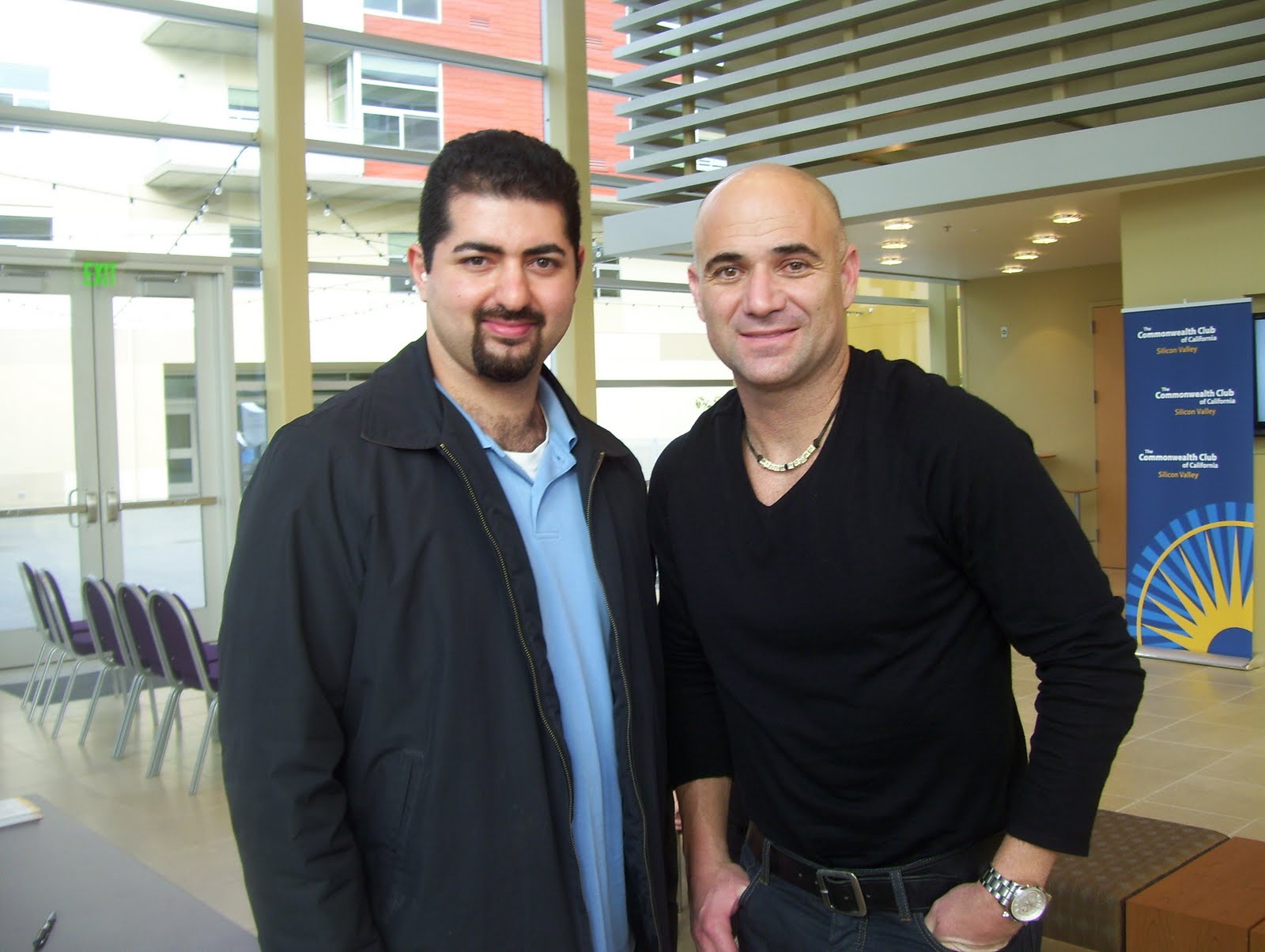
Andre Agassi came to Palo Alto, California last week. The Commonwealth Club hosted an interview and book signing. Andre Agassi oozes charm, intelligence, and charisma. Although not formally educated, Agassi's intelligence is palpable, but so is his need for acceptance and his sensitivity to criticism. Joel Drucker, a reporter who recently reviewed Agassi's book, Open, was on the receiving end of a few barbs from Agassi. Few people can single out a reporter during an interview and still come out looking good, but Agassi's charisma allows him to say things almost no one else can say.
I look forward to reading Agassi's book. In the meantime, here are some snippets I remember from the interview:
On Michael Chang: Agassi found Chang's habit of crediting God for his wins "odd." He said if Chang had blamed God when he lost, he would have had more respect for him.
On His Father: if he had to do it all over again, he wouldn't have changed anything, except he would have pushed Agassi into baseball or golf. Apparently, Agassi's father believes that baseball and golf athletes play longer and make more money.
On Tennis: Agassi mentioned the loneliness of the sport and said no other sport is as lonely. As a result, Agassi joked that tennis players like to talk to themselves a lot, and also answer their own questions.
On Coach Brad Gilbert: he talks a lot, but in the middle of one particularly frustrating match, he was very quiet. When Agassi told him, "Now's the time you stay silent?" Gilbert, obviously incensed at Agassi's failure to perform up to his potential, responded, "What do you want me to say? Let me make this as simple as I can. See the ball; run to the ball; hit the ball. If you can't do that, then just do what the other guy is doing!" Agassi went on to win the match.
On His Dad's Iranian Connection: Agassi said his dad--ethnically Armenian, but born and raised in Iran--never taught him Farsi, so he doesn't feel a connection with Iran. He said his dad pursued the American dream by coming to America. At the same time, Agassi, ever the diplomat, said he was curious about Iranian culture.
I was disappointed, because growing up, Agassi was the closest thing to a cool Iranian celebrity. All the Iranian kids looked up to Agassi, just like all the Chinese kids looked up to Michael Chang. As my friend said, when Michael Chang, a Chinese tennis player, won the French Open, "all the Chinese kids (myself included) decided to pick up a racket."
On Roger Federer: Agassi called Federer a freak of nature and said he was the greatest of all time.
On His Son: after his son threw a tennis ball at Agassi's dad, his dad told Agassi if his son ever did that again, he'd kick his butt so hard, his son wouldn't sh*t for a week. Agassi's son responded with more curiosity than fear, asking, "Is that possible?"
On Charter Schools: Agassi has opened a charter school and said he favors the charter school system because charter schools are able to demand additional requirements (such as mandating parental involvement) and to terminate bad teachers. When someone asked if Agassi would send his own kids to the charter school, Agassi responded that the kids were chosen through a lottery system over which he had no control, but even if his kids were accepted, his school was for children who had no other options. Agassi said he didn't want one of his kids taking a spot from someone else with fewer options.
Father-in-Law: [from the book] the first time Andre's and Steffi's fathers met each other, they almost got into a fistfight.
Bonus: the NYT's book review is here (November 20, 2009, Sam Tanenhaus).
Monday, November 23, 2009
Omar Khayyam: 1,000th Post
From Omar Khayyam's Ruba'iyat:
If I'm drunk on forbidden wine, so I am! / And if I'm an unbeliever, a pagan, or idolater, so I am! / Every sect has its own suspicions of me, / I myself am just what I am.
My rule of life is to drink and be merry, / To be free from belief and unbelief is my religion: / I asked the Bride of Destiny her bride-price, / "Your joyous heart," she said.
Due to a high metabolism, I don't feel any positive effects from drinking, so Khayyam's "forbidden wine" gives me no succor. Even so, I appreciate good poetry, and I am using his words to commemorate my 1,000th post on this blog. (At least I think this is the 1,000th post.)
I'll buy myself an eggnog latte later as a reward. For my regular readers, I hope you continue to enjoy my blog. As always, thanks for reading.
If I'm drunk on forbidden wine, so I am! / And if I'm an unbeliever, a pagan, or idolater, so I am! / Every sect has its own suspicions of me, / I myself am just what I am.
My rule of life is to drink and be merry, / To be free from belief and unbelief is my religion: / I asked the Bride of Destiny her bride-price, / "Your joyous heart," she said.
Due to a high metabolism, I don't feel any positive effects from drinking, so Khayyam's "forbidden wine" gives me no succor. Even so, I appreciate good poetry, and I am using his words to commemorate my 1,000th post on this blog. (At least I think this is the 1,000th post.)
I'll buy myself an eggnog latte later as a reward. For my regular readers, I hope you continue to enjoy my blog. As always, thanks for reading.
Sunday, November 22, 2009
Want to Learn More about Iran and Nuclear Weapons?
If you want to learn more about Iran and nuclear weapons, you have to listen to Nobel Peace Prize winner Mohamed ElBaradei. Charlie Rose interviewed him in 2007. See here.
Saturday, November 21, 2009
Dodgeball and Evolution
Barry Petchesky cracks me up.
A kid got nailed in the face during a dodgeball game at his school, and now he might sue the city. Maybe he needs to sue evolution for not giving him the reflexes to survive in middle school gym class.
I think I understand what happened here. Kid gets hit in the face, incurs about 15 grand in dental work, and someone has to pay for it. Parents probably don't have 15 grand to pay a dentist or dental insurance, so they need to get the money from somewhere...and they sue. The city, which runs the school, offers to give the lawyer 5 grand and the kid 15 grand to avoid lawyers' fees and a sympathetic jury.
Who's ultimately on the hook? NYC taxpayers. And you know what? I'm okay with that.
A kid got nailed in the face during a dodgeball game at his school, and now he might sue the city. Maybe he needs to sue evolution for not giving him the reflexes to survive in middle school gym class.
I think I understand what happened here. Kid gets hit in the face, incurs about 15 grand in dental work, and someone has to pay for it. Parents probably don't have 15 grand to pay a dentist or dental insurance, so they need to get the money from somewhere...and they sue. The city, which runs the school, offers to give the lawyer 5 grand and the kid 15 grand to avoid lawyers' fees and a sympathetic jury.
Who's ultimately on the hook? NYC taxpayers. And you know what? I'm okay with that.
Friday, November 20, 2009
Book Recommendation: The Assist
I recently finished a great book, Neil Swidey's The Assist. The author shadows a Boston high school basketball team and their driven coach. Along the way, the author examines busing, racial issues, the judicial system, and the code of the streets. Imagine Hoop Dreams crossed with Boyz in the Hood.
On white flight in Boston's neighborhoods: "The sad fact, she said, is most whites aren't comfortable being in the minority, and unless they can be guaranteed a school where they are in the majority, most of them won't return to the public schools." (page 107, paperback, Public Affairs, 2008)
On the origins of basketball: "In December 1891, James Naismith, a thirty-year-old phys-ed teacher at the School for Christian Workers, nailed two half-bushel peach baskets to the edge of an elevated indoor track, divided his eighteen stir-crazy students into two teams of nine, and taught them to bounce a fat ball and toss it at their side's basket. There were no holes at the bottom of the baskets, so Naismith kept a ladder nearby for use after each score." (page 87)
From an experienced school administrator: "Kids are no damn good!" [Headmaster Michael] Fung would tell all the wide-eyed recent college grads he hired to rejuvenate his faculty. "They leave the school a mess. They don't listen. They swear." Then he would pause for effect. "That's why we have to work hard to make them good." (page 168)
Fung advised the teacher[that] students must be taught to respect boundaries. No, the teacher replied, she wanted teach them that they are respected and trusted. Not long after that, her students stole her lunch. Then her credit card. Then her $300 jacket, which they set on fire. She no longer worked at Charlestown High. (page 171)
On Criminal Law: "Do we have a Bruton problem?" he asked, invoking a Supreme Court ruling that had become shorthand for trials of co-defendants that get stuck in a goulash of blame. (page 292)
On white flight in Boston's neighborhoods: "The sad fact, she said, is most whites aren't comfortable being in the minority, and unless they can be guaranteed a school where they are in the majority, most of them won't return to the public schools." (page 107, paperback, Public Affairs, 2008)
On the origins of basketball: "In December 1891, James Naismith, a thirty-year-old phys-ed teacher at the School for Christian Workers, nailed two half-bushel peach baskets to the edge of an elevated indoor track, divided his eighteen stir-crazy students into two teams of nine, and taught them to bounce a fat ball and toss it at their side's basket. There were no holes at the bottom of the baskets, so Naismith kept a ladder nearby for use after each score." (page 87)
From an experienced school administrator: "Kids are no damn good!" [Headmaster Michael] Fung would tell all the wide-eyed recent college grads he hired to rejuvenate his faculty. "They leave the school a mess. They don't listen. They swear." Then he would pause for effect. "That's why we have to work hard to make them good." (page 168)
Fung advised the teacher[that] students must be taught to respect boundaries. No, the teacher replied, she wanted teach them that they are respected and trusted. Not long after that, her students stole her lunch. Then her credit card. Then her $300 jacket, which they set on fire. She no longer worked at Charlestown High. (page 171)
On Criminal Law: "Do we have a Bruton problem?" he asked, invoking a Supreme Court ruling that had become shorthand for trials of co-defendants that get stuck in a goulash of blame. (page 292)
Thursday, November 19, 2009
Where Did the Stimulus Money Go?
Wondering how the stimulus money is being spent? You can look up various beneficiaries online. Here is the breakdown for Santa Clara County. Most of the money went to school districts. Teachers' unions have major pull nationwide, and California is no exception.
According to a recent Pew Center report, the ten most financially troubled states are: Arizona, California, Florida, Illinois, Michigan, Nevada, New Jersey, Oregon, Rhode Island and Wisconsin. Also, Colorado, Georgia, Kentucky, New York and Hawaii are suffering fiscal problems.
According to a recent Pew Center report, the ten most financially troubled states are: Arizona, California, Florida, Illinois, Michigan, Nevada, New Jersey, Oregon, Rhode Island and Wisconsin. Also, Colorado, Georgia, Kentucky, New York and Hawaii are suffering fiscal problems.
Wednesday, November 18, 2009
More Wisdom from Dick Armey
Republican Dick Armey:
Reagan went to Berlin and said, "Tear down this wall." We [Republicans] went to San Diego and said, "Build a fence." It was just stupid. You have Hispanics saying, "I’m not going to vote for those guys because they don’t like me."
More from Dick Armey here and here.
Reagan went to Berlin and said, "Tear down this wall." We [Republicans] went to San Diego and said, "Build a fence." It was just stupid. You have Hispanics saying, "I’m not going to vote for those guys because they don’t like me."
More from Dick Armey here and here.
Tuesday, November 17, 2009

Sarah Palin, Oprah, and Cheers
I stayed up late watching a DVD, and when I turned off the television, Fox (Channel 2 here) was showing a Cheers episode. The title of the 1993 episode was "Woody Gets an Election." (Season 11, Episode 21) In this episode, Frasier convinces the hapless Woody Boyd--a genial but vacuous bartender--to run for City Council. Frasier's goal is to create an experiment proving voter ineptitude. Frasier first tells Sam Malone that a monkey could get 10% of the vote, but then tells Sam he'll go one better--he will bet that Woody Boyd can get 10% of the vote:
Look, all I'm saying is that when it comes to voting, people just shut off their brains. I submit we could put a chimpanzee on the ballot and garner ten percent of the vote.
Sam and Frasier make the bet, and we're off to the races. (Anti-Obama people will love Frasier's advice to Woody--just come up with something about "change," he says.) In the middle of the election, Frasier dreams that Woody will eventually move up in the political ranks, become president, and then blow up the entire world. Waking from his nightmare, Frasier convinces Woody to drop out of the race. Even though Woody tells the public he is quitting the race, he wins the election anyway when his wife announces she is pregnant. After Woody's successful election, a despondent, guilt-ridden Frasier believes he has brought about the extinction of the human race as we know it.
As I am watching this episode, I flip to another channel. It's a repeat of Sarah Palin's interview yesterday with Oprah. I keep watching the Cheers episode, and I start wondering whether I've swallowed the red pill ("You take the blue pill--the story ends, you wake up in your bed and believe whatever you want to believe. You take the red pill--you stay in Wonderland and I show you how deep the rabbit-hole goes."). I soon realize art is imitating life.
Some of Woody's comments could match up identically with Sarah Palin's words--just switch "hockey mom" with "farmboy" to eliminate the gender issue, and then go watch the Cheers episode. For example, Woody says plenty of folksy stuff about cleaning up city hall--he says he just knows what's on the farm, and as a simple farmboy, he wants to clean up the rats, because with the rats, you won't have a barn. The reporter--who later plays Roz on Frasier's own show--walks away, saying she's never heard such corny stuff, but she's inclined to believe Woody can pull it off. I started thinking about Sarah Palin's anti-corruption campaign promises and her folksy sayings, and the similarities between Sarah Palin and Woody stunned me.
In case you're wondering, Sarah Palin did a decent job in the Oprah interview. She came across as a nice, active mom who loves her family--just like the Woody character comes across as a decent, nice guy who loves his wife. As I watched the interview, I realized Sarah Palin believes that being a decent person is enough to run for office. In other words, if you're not a liar, not evil, and you believe in God, why can't you do good things in public office? It's sort of like asking,"Why can't Woody Boyd represent Boston well?"
Anything's possible, right? Except that these days, being a politician requires more than just being a good person. It means being able to interpret and write good laws. It means being smart enough to understand the intricacies of various legal procedures. It means having more than basic knowledge of American history and economics. It means being able to juggle special interests--public sector unions, corporations, small businesses, etc.--with doing what's right for the people. (San Jose Councilmember Pete Constant needs to do a better job in this regard. As an ex-cop, he did the police union's bidding and voted against government transparency, and then seems to have given me a bogus reason for voting against it. For more, see here).
Now, Sarah Palin might believe she can hire staff members who can handle all the tough, tedious details for her. But the culture of any institution starts at the top. If the leader lacks understanding and direction when it comes to details, the entire organization will eventually get sloppy. We've already seen that phenomenon with George W. Bush: someone interprets a Rumsfeld memo to mean that torturing detainees is perfectly fine. The CIA starts torturing the wrong people and then instead of coming clean, it tries to cover up its mistakes. Instead of complying with reasonable information requests, the DOJ starts finding technical reasons to deny them. And so on. We've already seen what happens when a nice, decent person gets into office. It's a total disaster. After experiencing the George W. Bush years, why would anyone listen to Sarah Palin? She's got as much credibility as Woody Boyd.
Fittingly, the final scene of the Cheers episode shows a nuclear bomb exploding. (Matt "She's Going to Have the Nuclear Codes" Damon would be proud.)
Look, all I'm saying is that when it comes to voting, people just shut off their brains. I submit we could put a chimpanzee on the ballot and garner ten percent of the vote.
Sam and Frasier make the bet, and we're off to the races. (Anti-Obama people will love Frasier's advice to Woody--just come up with something about "change," he says.) In the middle of the election, Frasier dreams that Woody will eventually move up in the political ranks, become president, and then blow up the entire world. Waking from his nightmare, Frasier convinces Woody to drop out of the race. Even though Woody tells the public he is quitting the race, he wins the election anyway when his wife announces she is pregnant. After Woody's successful election, a despondent, guilt-ridden Frasier believes he has brought about the extinction of the human race as we know it.
As I am watching this episode, I flip to another channel. It's a repeat of Sarah Palin's interview yesterday with Oprah. I keep watching the Cheers episode, and I start wondering whether I've swallowed the red pill ("You take the blue pill--the story ends, you wake up in your bed and believe whatever you want to believe. You take the red pill--you stay in Wonderland and I show you how deep the rabbit-hole goes."). I soon realize art is imitating life.
Some of Woody's comments could match up identically with Sarah Palin's words--just switch "hockey mom" with "farmboy" to eliminate the gender issue, and then go watch the Cheers episode. For example, Woody says plenty of folksy stuff about cleaning up city hall--he says he just knows what's on the farm, and as a simple farmboy, he wants to clean up the rats, because with the rats, you won't have a barn. The reporter--who later plays Roz on Frasier's own show--walks away, saying she's never heard such corny stuff, but she's inclined to believe Woody can pull it off. I started thinking about Sarah Palin's anti-corruption campaign promises and her folksy sayings, and the similarities between Sarah Palin and Woody stunned me.
In case you're wondering, Sarah Palin did a decent job in the Oprah interview. She came across as a nice, active mom who loves her family--just like the Woody character comes across as a decent, nice guy who loves his wife. As I watched the interview, I realized Sarah Palin believes that being a decent person is enough to run for office. In other words, if you're not a liar, not evil, and you believe in God, why can't you do good things in public office? It's sort of like asking,"Why can't Woody Boyd represent Boston well?"
Anything's possible, right? Except that these days, being a politician requires more than just being a good person. It means being able to interpret and write good laws. It means being smart enough to understand the intricacies of various legal procedures. It means having more than basic knowledge of American history and economics. It means being able to juggle special interests--public sector unions, corporations, small businesses, etc.--with doing what's right for the people. (San Jose Councilmember Pete Constant needs to do a better job in this regard. As an ex-cop, he did the police union's bidding and voted against government transparency, and then seems to have given me a bogus reason for voting against it. For more, see here).
Now, Sarah Palin might believe she can hire staff members who can handle all the tough, tedious details for her. But the culture of any institution starts at the top. If the leader lacks understanding and direction when it comes to details, the entire organization will eventually get sloppy. We've already seen that phenomenon with George W. Bush: someone interprets a Rumsfeld memo to mean that torturing detainees is perfectly fine. The CIA starts torturing the wrong people and then instead of coming clean, it tries to cover up its mistakes. Instead of complying with reasonable information requests, the DOJ starts finding technical reasons to deny them. And so on. We've already seen what happens when a nice, decent person gets into office. It's a total disaster. After experiencing the George W. Bush years, why would anyone listen to Sarah Palin? She's got as much credibility as Woody Boyd.
Fittingly, the final scene of the Cheers episode shows a nuclear bomb exploding. (Matt "She's Going to Have the Nuclear Codes" Damon would be proud.)
Florida Man Attacks Greek Priest
A few thoughts on this story, about a Marine attacking a Greek priest he mistook for a Muslim terrorist:
1) The judge set bail at only $7,500? Seriously?
2) Even though the Marine believed the priest was about to blow himself up, he still pursued him with a tire iron rather than seek a safe distance; and
3) Hopefully, we can put to rest the idea that demonizing Muslims will only hurt Muslims.
That is all. Sigh.
Monday, November 16, 2009
Defending Elizabeth Lambert?
I found an article defending the University of New Mexico's assassin, er, player Elizabeth Lambert. The internet has everything! Here ya go:
http://deadspin.com/5398883/elizabeth-lambert-is-now-americas-greatest-villain
Junior Elizabeth Lambert is the Loco Lobo whom cameras caught bringing the pain down on BYU in the Mountain West women's soccer semifinals. She kicked, she punched, she clawed, she yanked and basically slugged her way to global infamy. Not since Zinedine Zidane has the world cared so much about soccer players hurting each other.
Girls will be girls?
http://deadspin.com/5398883/elizabeth-lambert-is-now-americas-greatest-villain
Junior Elizabeth Lambert is the Loco Lobo whom cameras caught bringing the pain down on BYU in the Mountain West women's soccer semifinals. She kicked, she punched, she clawed, she yanked and basically slugged her way to global infamy. Not since Zinedine Zidane has the world cared so much about soccer players hurting each other.
Girls will be girls?
Sunday, November 15, 2009
Music Vids from All over the World
National Geographic keeps impressing me. In addition to having a great holiday gifts catalog, they have a treasure trove of international music videos on their website. The site includes Brazilian, flamenco (check out Estrella Morente's Volver), Arabic pop, and even "Garifuna music." Here is K'naan's "Soobax."
Saturday, November 14, 2009
Muhammad Ali: How He Wanted to Be Remembered
I recently finished reading David Remnick's biography of Muhammad Ali, King of the World. The book was so good, I actually dragged out the reading because I didn't want it to end. Ali tells us how he wants to be remembered:
As a black man who won the heavyweight title and who was humorous and who treated everyone right. As a man who never looked down on those who looked up to him and who helped as many of his people as he could--financial[ly] and also in their fight for freedom, justice, and equality. As a man who wouldn't embarrass them. As a man who tried to unite his people through the faith of Islam...
May Allah forever bless the Greatest of All Time.
As a black man who won the heavyweight title and who was humorous and who treated everyone right. As a man who never looked down on those who looked up to him and who helped as many of his people as he could--financial[ly] and also in their fight for freedom, justice, and equality. As a man who wouldn't embarrass them. As a man who tried to unite his people through the faith of Islam...
May Allah forever bless the Greatest of All Time.
Friday, November 13, 2009
Gov Pensions Bankrupting Taxpayers?
This article scared me, until I realized not enough people will care, so the problem will be forgotten soon enough. What the heck, it's only 22 billion dollars, right?
The [government pension insurance] fund still has plenty of money to operate now. But unless pension funds adopt less risky investment strategies or Congress raises insurance premiums, it eventually will run out of money to pay the [government worker] pensioners it supports.
At least our children are on the hook for these things. Way to look out for them, huh?
The [government pension insurance] fund still has plenty of money to operate now. But unless pension funds adopt less risky investment strategies or Congress raises insurance premiums, it eventually will run out of money to pay the [government worker] pensioners it supports.
At least our children are on the hook for these things. Way to look out for them, huh?
Guess Who?
Guess who said this?
I ain't no Christian. I can't be, when I see all the colored people fighting for forced integration getting blown up. They get hit by stones and chewed by dogs, and they blow up a Negro church and don't find the killers...Followers of Allah are the sweetest people in the world...All they want to do is live in peace.
Go ahead and google it now. We've come a long way, haven't we?
I ain't no Christian. I can't be, when I see all the colored people fighting for forced integration getting blown up. They get hit by stones and chewed by dogs, and they blow up a Negro church and don't find the killers...Followers of Allah are the sweetest people in the world...All they want to do is live in peace.
Go ahead and google it now. We've come a long way, haven't we?
Thursday, November 12, 2009
SNL on Obama
My favorite parts were the Glenn Beck impersonation and the King of Pop line. If you liked this one, go to www.hulu.com and check out Jon Stewart's "11/3 project."
Volokh Conspiracy on TX v. California
More on Texas v. California here. (The comments are especially fun to read.)
Californians used to dismiss Texans as back-water denizens with too much color on their necks. How quickly things change. Here's Bill Watkins echoing Meg Whitman:
Bill Watkins, executive director of the Economic Forecast Project at the University of California at Santa Barbara, has calculated that once you adjust for population growth and inflation, the state government spent 26 percent more in 2007-08 than in 1997–98. Back then, “California had teachers. Prisoners were in jail. Health care was provided for those with the least resources.” Today, Watkins asks, “Are the roads 26 percent better? Are schools 26 percent better? What is 26 percent better?”
I subscribe to the print edition, so here's another interesting tidbit from William Voegeli:
California government workers retiring at age 55 received larger pensions than their counterparts in any other state (leaving aside the many states where retirement as early as 55 isn't even possible)...The latest report shows 5,115 lucky members in this six-figure club [of government retirees receiving at least $100,000 annual pensions]. The state's annual bill for polishing their gold watches is $610 million.
California's public sector unions have obviously done quite well for themselves. As one person commented, "The dues paid to Club California buy benefits that, increasingly, are enjoyed by the staff instead of the members." The worst part? No one seems to care. Even my highly educated friends, who should know better, don't care.
Californians used to dismiss Texans as back-water denizens with too much color on their necks. How quickly things change. Here's Bill Watkins echoing Meg Whitman:
Bill Watkins, executive director of the Economic Forecast Project at the University of California at Santa Barbara, has calculated that once you adjust for population growth and inflation, the state government spent 26 percent more in 2007-08 than in 1997–98. Back then, “California had teachers. Prisoners were in jail. Health care was provided for those with the least resources.” Today, Watkins asks, “Are the roads 26 percent better? Are schools 26 percent better? What is 26 percent better?”
I subscribe to the print edition, so here's another interesting tidbit from William Voegeli:
California government workers retiring at age 55 received larger pensions than their counterparts in any other state (leaving aside the many states where retirement as early as 55 isn't even possible)...The latest report shows 5,115 lucky members in this six-figure club [of government retirees receiving at least $100,000 annual pensions]. The state's annual bill for polishing their gold watches is $610 million.
California's public sector unions have obviously done quite well for themselves. As one person commented, "The dues paid to Club California buy benefits that, increasingly, are enjoyed by the staff instead of the members." The worst part? No one seems to care. Even my highly educated friends, who should know better, don't care.
Wednesday, November 11, 2009
Talk is Cheap
If we really cared about our soldiers, wouldn't we have brought them home before 5,000+ of them died in Iraq and Afghanistan?
Wouldn't we have overwhelmingly voted against George W. Bush the second time, knowing we would place our soldiers in harm's way?
On this day of remembrance, will we remember our soldiers who are still in Iraq and Afghanistan, not just our soldiers at Fort Hood?
On this day, my thoughts are with Conik A. and his older brother, Nick, who are both serving in the military. I went to high school with both of them. Nic was ahead of me on the wrestling team, and he was too strong for me to take his varsity spot while he was on the team. I pray they both stay safe.
Governments and Secret Evidence: an Unholy, Unconstitutional Alliance?
This well-researched story in this month's Washington Lawyer magazine stunned me:
http://www.dcbar.org/for_lawyers/resources/publications/washington_lawyer/november_2009/privilege.cfm
[Khaled] El-Masri, a German citizen of Lebanese descent, was on vacation on New Year’s Eve 2003 in Macedonia when he was seized at a border crossing, tortured, and then flown to a secret prison in Afghanistan. He remained in a squalid cell for five months before his captors, realizing they had the wrong man, flew him to Albania and dumped him on a roadside, convinced no one would believe the story El-Masri would tell.
Want to guess who did this? It's the CIA. Under Dick Cheney, the CIA seems to have had no limits.
Mr. El-Masri sued, but the George W. Bush administration invoked the state secrets privilege--a presidential power intended to prevent public disclosure of classified information--to dismiss the lawsuit.
One judge has pushed back. See Mohamed v. Jeppesen Dataplan, Inc:
Judge Michael D. Hawkins said dismissing cases because the government alleges secrets are involved would “cordon off all secret government actions from judicial scrutiny, immunizing the CIA and its partners from demands and limits to the law.” The government’s argument has “no logical limit,” Hawkins wrote.
God bless judges that understand the judicial branch should check and limit unconstitutional use of executive power. The executive branch was never intended to be a dictatorship shielded from scrutiny. Whenever any government agency tries to hide information, my alarm bells go off. Right now, there's a five-alarm fire somewhere, and my taxpayer dollars are funding it.
http://www.dcbar.org/for_lawyers/resources/publications/washington_lawyer/november_2009/privilege.cfm
[Khaled] El-Masri, a German citizen of Lebanese descent, was on vacation on New Year’s Eve 2003 in Macedonia when he was seized at a border crossing, tortured, and then flown to a secret prison in Afghanistan. He remained in a squalid cell for five months before his captors, realizing they had the wrong man, flew him to Albania and dumped him on a roadside, convinced no one would believe the story El-Masri would tell.
Want to guess who did this? It's the CIA. Under Dick Cheney, the CIA seems to have had no limits.
Mr. El-Masri sued, but the George W. Bush administration invoked the state secrets privilege--a presidential power intended to prevent public disclosure of classified information--to dismiss the lawsuit.
One judge has pushed back. See Mohamed v. Jeppesen Dataplan, Inc:
Judge Michael D. Hawkins said dismissing cases because the government alleges secrets are involved would “cordon off all secret government actions from judicial scrutiny, immunizing the CIA and its partners from demands and limits to the law.” The government’s argument has “no logical limit,” Hawkins wrote.
God bless judges that understand the judicial branch should check and limit unconstitutional use of executive power. The executive branch was never intended to be a dictatorship shielded from scrutiny. Whenever any government agency tries to hide information, my alarm bells go off. Right now, there's a five-alarm fire somewhere, and my taxpayer dollars are funding it.
Tuesday, November 10, 2009
25 Random Things about Me
Note: added on November 10, 2015.
Written in 2009 on Facebook:
Written in 2009 on Facebook:
1. Two activities that changed my life were high school wrestling and coaching kids in basketball. Without wrestling, I wouldn't know how far I could push myself without breaking. I'd also be less willing to push myself to the limit when necessary. Without coaching, I'd have no idea how much children rely on adults to set standards of behavior. This realization caused me to become much more moderate.
2. My first year wrestling, I lost every single match. I almost won my last match, but couldn't hold onto a lead. Afterwards, I was so upset, I went to the bathroom and punched (kicked?) a hole through the wall. (Thankfully, I wasn't injured.) The next year, I won several matches, including a crucial match where I was supposed to be on injured reserve but came in at the last minute. Winning that match against Homestead High helped place my team in 3rd place in our league. That same year, my coach awarded me Most Valuable Frosh/Soph Wrestler. I wrestled all four years in high school, starting at the 152 lbs weight class and ending at the 171 lbs weight class.
3. I didn't experience my first kiss until college.
4. I didn't really study for the bar exam but somehow passed. Here's what happened: I opted for the take-home study program, and BarBri (an intensive study program) sent me the materials a week late. A week in bar prep time is an eternity. Realizing I could never catch up, I uncharacteristically gave up. Instead of studying, I played basketball in downtown Campbell with the SJSU women's team most days and spent most nights terrified and in fetal position. (I did manage to attend a 3 day PMBR course shortly before the bar exam, and I also took the Conviser Mini-Review with me to the hotel.)
The first day of the exam, I ticked off everyone sitting near me. I was making jokes and smiling, and they did not appreciate my insouciance. Everything I said was met with stone cold silence and glares. Anyway, the first day, the questions seemed pretty easy. I went back to the hotel, ate at Hungry Hunter, and read the Conviser study guide until 4AM. The next day, the subjects on the exam happened to be exactly the ones I'd studied.
The second day, I studied the Conviser mini-review from 12AM to 4AM. Well, the third day, the subjects once again happened to be mostly the ones I'd studied a few hours before. When I drove home after the exam, I'd had about 5 hours of sleep in three days and almost rear-ended a BMW. Later, when I checked online and found out I'd passed, I was so happy, I picked up the law firm's secretary and gave her a bear hug.
5. After taking the bar exam, my buddy (Joe) and I saw most of western Europe with no plans, no maps, and not much money. We went to London, took the Chunnel (aka Channel Tunnel) to Brussels and went clockwise. We ended up in Paris and took the Chunnel back to London. In one month, we managed to see almost every capital in Western Europe, walked 10+ miles a day, slept on benches (sometimes, we couldn't find an open hotel), got into a screaming match in Berlin (we made up later), and just had an incredible time. And before you ask, we did _not_ partake in any Amsterdam coffeeshops. My fav city was Venice, Italy. (I love London, too, but that's like a second home to me, so I don't count it in my list of favs.)
6. I went to first grade in Scotland. I have a pic of myself in full Scottish garb, kilt and all, to prove it.
7. I have a younger sister who is much, much smarter than me. She graduated from MIT and is getting her PhD at Harvard right now.
8. For a specific reason you may notice if you know me, I tend to prefer solitary activities, like reading or watching films. Socially, sometimes I feel I'm the male version of Eliza Doolittle.
9. I love reading. You will hardly ever see me without a book or newspaper. Some of my fav times are spent reading a book or newspaper in a bookstore while drinking a white choc mocha or cappuccino.
10. I welcome the J-Lo / Jessica Simpson / Kim Kardashian movement away from the Kate Moss era.
11. I've seen so many divorces in family court, I am fairly certain I will not get married. Other lawyers were paying me 100+ dollars to show up and do routine appearances for them in family matters. After a few months, I got so depressed, I stopped going. This was when I was first starting out on my own and desperately needed the money. Let me give you an example of how bad things can get. I went to court in Hayward (or somewhere in Alameda County) and the only issue to be decided was how to divide the couple's *debt*--they had no assets. After I got a continuance, the ex-husband was so upset, he angrily told me he was going to hire the best lawyer in town to beat his ex-wife in the case (with what money?). It would be comical if it wasn't so sad. After seeing so much irrational behavior, I do not want to put myself in a similar position. This doesn't, however, preclude me from being in a committed relationship--it just means I don't want some stranger/judge telling me what to do if things fall apart.
12. I paid off my private law school (Santa Clara Law) loans myself. It took about three years of eating nothing but PB&J sandwiches and staying in the office 12 hours a day (when you do nothing but work and then go home and sleep right after work, you don't have any opportunities to spend money). When I would forget my bag lunch, I wouldn't eat that day.
13. I have never bought a new car and probably never will. I bought my last car from a rental car company's fleet and paid cash for it.
14. If I could make a living doing it, I would love to write about public companies and finance instead of practicing law.
15. I am convinced women pick men based on height. I had no success with women at all until I hit 6 feet. Not much about me changed--just my height. So if I had to answer Freud's question about what women want, I would say it's pretty simple: 1) be tall; 2) don't be a jerk; and 3) have a job.
16. I'd like to think I have no ego. In a rebuke to sociologists and anthropologists everywhere, I'm not status-conscious at all. I don't buy nice labels or nice cars to look good. If someone hurts me, I just move on. I've realized over the years this makes me somewhat unusual. I genuinely don't care what other people do or say, as long as physical violence isn't involved. The only time I get upset is when people in power clearly abuse their discretion or authority. George Carlin would be proud.
17. I sometimes think about moving to a small town, buying a small house, and spending my days reading books and playing basketball. It's almost like deep down, I lack aggressive ambition, despite my degrees and high work ethic. Anthony Bourdain summed up this phenomenon perfectly, except I would *not* be doing the Mary Jane, and I'm not yet completely afraid of "that guy":
"I know there's deep inside (me) some lazy hippie who'd be perfectly happy to lay on the couch, smoke weed and watch The Simpsons all day - I'm really afraid of that guy. I don't like him. I don't want him around. And my whole life is kind of constructed to avoid reverting to that guy: Stay busy. Stay focused. Try not to mess up."
18. I am probably most happy when playing basketball. Seeing your work--whether on defense or offense--create immediate results is awesome.
19. I've had my own law firm since Nov(?) 2004. I hope I can keep it for a long time. If you're interested, go to www.rafatlaw.com for more info. [Update: closed the business in 2010.]
20. I am unfortunately ultra-cheap, er, frugal. I pick up pennies and change on the ground when I see them. I park about 1/2 a mile away from my office to pay lower parking fees. I own only a few suits, most of them bought at a Gilroy outlet during a sale. I don't think I've ever spent more than 300 dollars a year on clothing, and that includes suits. I told my family I wanted nothing for X-Mas or my birthday because I didn't want to spend any money on gifts for them, and we were all old enough to buy our own stuff. Recently, when I found out how much a crown cost, I asked my dentist to remove the entire tooth (the dentist and the other dentist I went to for a second opinion wouldn't do it, so I ended up (grudgingly) paying the 900 dollars). My largest monthly expenses are food-related. Neal Templin would be proud. So would Jeff Yeager.
21. I dislike driving long distances. The human body was not designed to be sitting for hours in a car. Also, the fact that I get lost all the time might have something to do with it.
22. My travels have taught me something I think is absolutely true--under normal circumstances, all human beings, no matter where they live, what they believe, and what they look like, all want the same things--a home, a job they like or are good at, someone to love, and someone to listen to them. Any differences are a matter of degree, not substance. The key is figuring out the other person's/culture's communication style so you can understand what's really being said.
Bill Simmons in S.F.

As part of his book tour, Bill Simmons visited S.F. on November 5, 2009. He apologized about not wearing his Golden State Warriors jersey, and then mistakenly praised Stephen Jackson. The crowd booed immediately at the sound of Stephen Jackson's name. (Jackson has publicly demanded a trade.) Apparently, Simmons interpreted the boos as a perfect segue to mention Chris Cohan, the much-hated Golden State Warriors owner. Simmons asked about the proper spelling of Cohan's name, which few people knew off the top of their heads. Then, without further ado, he sat down and started signing books.
Although Simmons is in his forties, he looks (and dresses) like he's in his late twenties. I suppose if my job consisted of watching sports and going to Vegas, I'd look perpetually young, too.
I read some of Simmons' book, and I liked it. He trashes my favorite player, Reggie Miller, but he does it in a way that allows me to still like him.
Monday, November 9, 2009
How to Judge a District Attorney
[Note: I revised the last two paragraphs to update facts relating to Vahid Hosseini's prosecution.]
Shouldn't the main factors used to judge a D.A.'s success be 1) winning trials; 2) managing costs, i.e. winning cases without overspending taxpayer monies; 3) not prosecuting unwarranted cases; and 4) promoting settlement when non-violent crimes, such as drug possession, are involved?
On these four factors, where is the evidence that Santa Clara County D.A. Dolores Carr has failed? Where is the evidence that challenger Jeff Rosen will do a better job than Attorney Carr on these four factors? [Update: at this point, I had not met Mr. Rosen. Having met Mr. Rosen, I can tell you that he seems very motivated to bring a new culture to the D.A.'s office.]
I don't have a dog in the D.A. race, but I am curious why the SJ Mercury dislikes Attorney Carr so much. Scott Herhold, one of my favorite local columnists, trashed her in a recent column. See here. He also wrote, "I personally like to think I'm near the top of her enemies list." (Wow.)
I know Attorney Carr's husband was involved in an ethics issue, but I haven't heard of the D.A.'s office botching any major cases (Maybe I've missed something--and I consider the DeAnza case to be more of a tragedy than a missed opportunity to prosecute). I know prosecutor Benjamin T. Field allegedly committed ethical violations, but that wasn't necessarily Attorney Carr's fault.
Bottom line: the legal profession is monolithic enough as it is. District Attorneys tend to be hyper-aggressive, egotistical men with Superman complexes. (See here for further explanation.) I like the idea of having a female D.A., even though I realize gender has nothing to do with competence. Plus, I don't know much about challenger Jeff Rosen, and it seems to me that the devil you know is better than the devil you don't.
At the same time, I am a harshly judgmental voter. Some readers may remember that the Santa Clara County D.A.'s office transferred the prosecution of Vahid Hosseini's alleged killers to the state AG's Office (Attorney Geoff Lauter?). The D.A.'s office may have transferred the case to avoid making Attorney Carr the centerpiece of an "O.J. Simpson, 'local law enforcement is corrupt'" defense strategy. If, however, the AG's Office fails to convict the killer and his alleged accomplices, I may vote against the incumbent D.A. Is that unfair, given that Attorney Carr's office is no longer responsible for the Vahid Hosseini case? Perhaps. But to me and many others, not putting Vahid Hosseini's killer(s) in jail would be a monumental failure worthy of widespread blame.
[Update on November 10, 2009: One person has questioned my comments regarding the transfer of the Vahid Hosseini case. Apparently, Attorney Carr's office would not have had to transfer the case to the AG if the Mercury News hadn't raised issues about a possible conflict with Attorney Carr's husband being hired by Mrs. Hosseini's civil lawyer. (Mrs. Hosseini hired Attorney Carr's husband to investigate protocols used by bank security personnel in a separate civil lawsuit.) In short, Attorney Carr may have transferred the Hosseini case not because she had to do so, but because she wished to avoid the appearance of impropriety.]
Updates on June 22, 2010 and April 7, 2011: Mr. Rosen won the D.A.'s race by a razor-thin margin. More here on his swearing-in ceremony and an important change in the prosecution's procedures.
Shouldn't the main factors used to judge a D.A.'s success be 1) winning trials; 2) managing costs, i.e. winning cases without overspending taxpayer monies; 3) not prosecuting unwarranted cases; and 4) promoting settlement when non-violent crimes, such as drug possession, are involved?
On these four factors, where is the evidence that Santa Clara County D.A. Dolores Carr has failed? Where is the evidence that challenger Jeff Rosen will do a better job than Attorney Carr on these four factors? [Update: at this point, I had not met Mr. Rosen. Having met Mr. Rosen, I can tell you that he seems very motivated to bring a new culture to the D.A.'s office.]
I don't have a dog in the D.A. race, but I am curious why the SJ Mercury dislikes Attorney Carr so much. Scott Herhold, one of my favorite local columnists, trashed her in a recent column. See here. He also wrote, "I personally like to think I'm near the top of her enemies list." (Wow.)
I know Attorney Carr's husband was involved in an ethics issue, but I haven't heard of the D.A.'s office botching any major cases (Maybe I've missed something--and I consider the DeAnza case to be more of a tragedy than a missed opportunity to prosecute). I know prosecutor Benjamin T. Field allegedly committed ethical violations, but that wasn't necessarily Attorney Carr's fault.
Bottom line: the legal profession is monolithic enough as it is. District Attorneys tend to be hyper-aggressive, egotistical men with Superman complexes. (See here for further explanation.) I like the idea of having a female D.A., even though I realize gender has nothing to do with competence. Plus, I don't know much about challenger Jeff Rosen, and it seems to me that the devil you know is better than the devil you don't.
At the same time, I am a harshly judgmental voter. Some readers may remember that the Santa Clara County D.A.'s office transferred the prosecution of Vahid Hosseini's alleged killers to the state AG's Office (Attorney Geoff Lauter?). The D.A.'s office may have transferred the case to avoid making Attorney Carr the centerpiece of an "O.J. Simpson, 'local law enforcement is corrupt'" defense strategy. If, however, the AG's Office fails to convict the killer and his alleged accomplices, I may vote against the incumbent D.A. Is that unfair, given that Attorney Carr's office is no longer responsible for the Vahid Hosseini case? Perhaps. But to me and many others, not putting Vahid Hosseini's killer(s) in jail would be a monumental failure worthy of widespread blame.
[Update on November 10, 2009: One person has questioned my comments regarding the transfer of the Vahid Hosseini case. Apparently, Attorney Carr's office would not have had to transfer the case to the AG if the Mercury News hadn't raised issues about a possible conflict with Attorney Carr's husband being hired by Mrs. Hosseini's civil lawyer. (Mrs. Hosseini hired Attorney Carr's husband to investigate protocols used by bank security personnel in a separate civil lawsuit.) In short, Attorney Carr may have transferred the Hosseini case not because she had to do so, but because she wished to avoid the appearance of impropriety.]
Updates on June 22, 2010 and April 7, 2011: Mr. Rosen won the D.A.'s race by a razor-thin margin. More here on his swearing-in ceremony and an important change in the prosecution's procedures.


Sunday, November 8, 2009
2009 Golden State Warriors: My Solution
The Warriors need to switch to a D'Antoni/Phoenix style offense using PG Ellis, SG Morrow, PF Randolph, SF Jackson, and C Biedrins. Right now, Maggette slows down the offense and the Warriors rise and fall with his inconsistent (read: generally poor) shooting.
Also, the Warriors should trade Maggette and either Azubuike or Jackson for Channing Frye and Barbosa. The trade would benefit both Phoenix and the Warriors. (Of course, the fact that it makes perfect sense for both teams automatically means the trade will never happen.)
Overall, the Warriors have excellent young talent. They should do whatever it takes to keep all of their young players, even if it means dumping Jackson and other veterans.
Also, the Warriors should trade Maggette and either Azubuike or Jackson for Channing Frye and Barbosa. The trade would benefit both Phoenix and the Warriors. (Of course, the fact that it makes perfect sense for both teams automatically means the trade will never happen.)
Overall, the Warriors have excellent young talent. They should do whatever it takes to keep all of their young players, even if it means dumping Jackson and other veterans.
Subscribe to:
Comments (Atom)