Saturday, February 9, 2019

Quebec: Avoid at all Costs (Unless It's Winter Carnaval)

Québec is a developing province masquerading as developed. Take away Toronto, Vancouver, and Calgary, and all of Canada looks like a U.S. satellite with natural resource and product sales dependent on a foreign navy. 
You'd have to be a fan of Marquis de Sade--the receiving end--to want to live in Quebec, so of course this is where the Canadian government placed many of its Syrian refugeesThe weather gets colder and more intolerable as you move farther Northeast, making Quebec City less hospitable than Montreal. One local artist remarked, "It's a freezer and it's raining ice cubes." 
At Winter Carnaval, an enjoyable annual event
He wasn't kidding. Imagine a third-tier San Francisco, just as expensive (except for housing) and colder--that's Quebec most months out of the year, thanks to onerous taxes and regulations. See this convoluted Uber receipt in Montreal? 
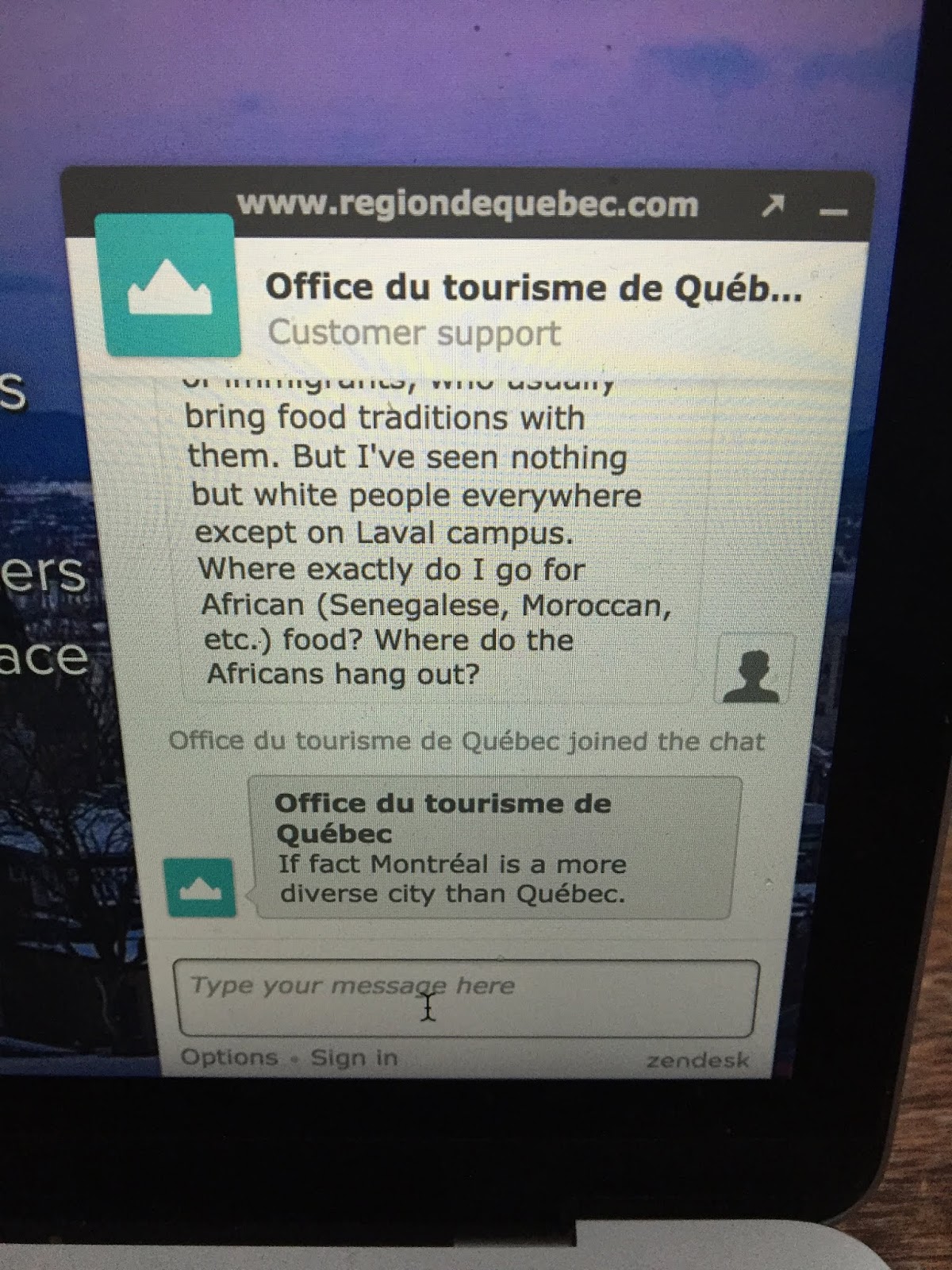
A twelve minute ride anywhere will cost about 10 USD, higher than most major metropolises. In Quebec City, I was charged 55 Canadian cents because the driver waited less than one minute while I put my backpacks in the trunk of his car. (It's automatically added as a "waiting fee.") Where do these taxes go? As far as I can tell, to white residents so they can have government jobs. 100% of the police officers, 90% of the bus drivers, 90% of Montreal's Metro workers, and 100% of the school crossing guards I saw were white. 
Despite aiming for égalité, the Québecois lack a single distinguished author or director. David Suzuki is from British Columbia; Anna Porter, Alice Munro, Robertson Davies, and Margaret Atwood are from Ontario; and Jacques Poitras and Charlotte MacLeod hail from New Brunswick. Who's Quebec's best-selling international author? Here's the blurb from one of his latest books: 

For fans of Stephen King’s Misery and Jo Nesbø’s The Snowman comes an engrossing thriller about a monster who becomes a victim and a victim who becomes a monster. From Patrick Senécal, the Quebec author who has sold over a million books worldwide. 

Sigh. (If you argue Wajdi Mouawad, Jean-Marc Vallée, Chrystine Brouillet, and Simon Boulerice are Quebec's artistic "heavyweights," you've lost the debate--none of them have created anything memorable and widely distributed. As for Leonard Cohen, he achieved success only after moving from Montreal to New York in 1967. He died in the United States.) 

How is it that every other country with Muslim or African immigrants can claim credit for producing some of the world's best literature and art? Chimamanda Ngozi Adichie attended three American universities. The U.K. has Zadie Smith, born in London to a Jamaican mother. America has Dominican-born Junot Diaz. We haven't even discussed sports (the 2018 French soccer/football team, coached by Zinedine Zidane) or music (Senegalese-American Akon), and we won't, because it would take too damn long to list all the accomplishments. 

You'd think a province with so little going for it would at least be dignified, but the Quebécois can't manage even that simple task. As far as they're concerned, they're bloody victims: "[T]here is an understandable strain of anger running through much Quebecois writing—an anger arising out of more than 150 years of oppression and marginalization at the hands of a dominant culture and language." 

To summarize, they believe being forced to speak English is an affront worse than slavery that justifies millions of taxpayer dollars to support Francophone culture. (Pro tip: you can't buy class or culture, but that hasn't stopped anyone yet.) Sadly, tax dollars promoting Francophone culture seem wasted because they boost only French-speaking collections rather than bridges towards a truly bilingual society. 
Available only in French
When not discriminating against English speakers, Quebec taxpayers also enjoy financing the translation of works from other countries into French but not English, sowing the seeds for future civil war--or separatism. Unsurprisingly, Quebec has tried to separate from English-speaking Canada two times: in 1980 and in 1995. In 1980, PM Pierre Trudeau, current PM Justin's father, negotiated an uneasy peace. In 1995, Quebec narrowly avoided secession when 50.58% voted to remain. 

Today, Quebec's economy is tied to the aerospace (aka military-industrial complex
At Fairmont Le Chateau Frontenac hotel, often featured in Hollywood movies
and finance sectors, plus its ports. 
From the small Bank of Montreal museum
Quebec City's Museum of Civilization discusses its economic history of making shoes, 
guns, then--I kid you not--a scientific Golden Age from 1990 to 2000: "Several large biomedical companies called Quebec City home from 1990 to 2000... Today, the life science industry consists of more than 100 companies providing nearly 6,000 jobs... with sales [not profits!] of 1.3 billion dollars." (For comparison purposes, Eli Lilly & Company, just one American life science company, generates about 20 billion USD in annual revenue.) 

What brilliant innovation occurred post-2000 in Quebec? Video games, and the local museum showcases American-distributed Guitar Hero. (I swear I am not making this up.) Quebec does indeed invest heavily in the video game sector--it provides tax credits up to 37.5% of employee salaries to attract talent. One major recipient of the tax credit is formerly France-based Guillaume Provost, who returned to Quebec: "native to Montreal, he has lived anywhere but..." If it sounds like Quebec has to pay millions not to lose its best people to other countries and to Toronto, you're not wrong. 

As for finance, the sector's influence is particularly interesting because it helps prove the West's economic development as historically driven by military and banking alliances. Murals of fallen soldiers in WWI and WWII are solemnly displayed in large banks, and justifiably so. 
Without war, capture of other countries' resources, and the implementation of legal and insurance systems designed to guarantee profits, modern Western governments seem flummoxed in having to adapt to other, more sustainable methods of economic development. 

"All the colonial wars for the last 25 years have been fought in the interests of capital; fought to ensure markets that would guarantee more profits for European capital. Capital has become very powerful, all-powerful. Capital decides the fate of humanity." -- Pramoedya Ananta Toer, This Earth of Mankind (translated from Indonesian in 1980)  

"The United States is now the number-one producer of oil and natural gas anywhere in the world — and now, for the first time in 65 years, we are a net exporter of energy." -- USA President Donald Trump, February 5, 2019 

Regardless, Quebec's economy continues to be tied to America's, for better or for worse.
When your economy revolves around your neighbor... 
Alan Phillips, Nat'l Geographic, December 1961.
Majority-USA owned cos "control more than 70% of Canada's oil industry."
Such dependency explains why Canada could not decline the U.S.'s demand to arrest Huawei executive Meng Wanzhou in a brazen attempt to influence U.S-China trade negotiations. Her arrest could be a nearly fatal self-inflicted wound, because most Canadian apparel products are manufactured in China or Cambodia, and Canada's major housing markets west of Quebec are propped up by Chinese investors and Chinese foreign exchange students paying rent (and outsized tuition). 

Moreover, due to its vast size and few heavily populated cities, Canada's mobile and physical infrastructures are underdeveloped. Though competition does exist between domestic mobile providers, no foreign companies--not even global behemoth T-Mobile--have bothered to set up shop. Consequently, if you're a tourist, basic service will cost you a frostbitten arm and a leg, and only Canada among developed nations sells prepaid monthly plans offering meager starting packets of 2GB to 4GB. (I considered a roaming package from Britain's Vodafone before seeing a bonus deal from Koodo Mobile.) 
The modern U.K. economy, like many developed countries, seems dependent on surveillance capabilities.
In short, it's not a good time to antagonize Huawei Technologies, but that's exactly where Canada is, courtesy of the United States. A smart PM would invite Chinese, European, and American mobile companies to invest and compete subject to data localization requirements; however, without subsidies possibly banned under WTO rules, Canada might be worried its domestic mobile companies are so weak, they'll all fold against outside competition. 

The entire situation reminds me of the Amana Colonies in also-freezing Iowa, where a culture of communal re-distribution of wealth worked well for one generation, but not two or three. 
Perhaps good times can survive more than three generations if funds are used for long-lasting physical infrastructure (trains, roads, etc.), but when you've reached the third generation in a non-innovative economy, there's a sense someone else--anyone but you, really--will handle things. 
No employees at a busy Metro station in Montreal
Service in all areas declines, then impacts the credibility of tax-receiving entities, who resort to propaganda to maintain funding. Immigrants are usually blamed, whether refugees or illegal, and if they're smart, they take their talents elsewhere
National Geographic, January or February 2019
A steady injection of well-targeted venture capital will improve prospects, but such economic weapons are rarely welcomed in a collaborative fashion (witness the worldwide struggles of Uber, Airbnb, Lime, etc.). Conflicts between newly funded players and established interests, while essential to progress, tear the social fabric. Worst case, Holocaust; best case, walls
From museum in Stockholm, Sweden
Even where collaboration is present, scaling a business without increasing segregation remains a challenge. Governments have yet to learn that neither laws nor taxes promote good behavior; the key is whether residents, citizens and non-citizens alike, feel connected to each other. The law, and its power to tax, are merely heavy tools to build--or break--social cohesion. 

Luckily for Quebec and other sub-zero locales, harsh weather provides perfect opportunities to establish credibility through the provision of public services, including transportation and snow shoveling. 
Outside McGill University, Quebec's top university
Each potential voter who wakes up and sees cleanly swept streets has less incentive to demonize governmental action. At that point, it's up to each politician to build on the credibility established by its winter crews, and some obviously do a better job than others. 

Speaking of social cohesion, I've yet to discuss Quebec's most horrific incident: the January 29, 2017 mosque shooting, where blue-eyed Quebecer Alexandre Bissonnette, a former Royal Canadian Army Cadet, used a rifle to murder six praying Muslims and to wound eight others. 
Ibrahima Barry (aged 39), Mamadou Tanou Barry (aged 42), Khaled Belkacemi (aged 60), Aboubaker Thabti (aged 44), Abdelkrim Hassane (aged 41) and Azzedine Soufiane (aged 57), all Canadian citizens, are no longer with us. 
At the Islamic Cultural Centre of Quebec City
The judge could have issued a sentence of 150 years but chose 40 years instead, meaning the children the shooter orphaned may once day walk the same streets as their parents' killer. Meanwhile, Canada's other Muslims aren't faring well, either. According to journalist Nadine Yousif, "three years later, Alsaleh’s story, and that of other [refugee] families, is of feeling stuck. In Arabic, Alsaleh told me she misses her home in Syria, but that home is no longer there, and Canada still feels like a strange land, 'like you’re in a country that isn’t yours.'" 
F*ck you, Quebec. F*ck you and this whole province and everyone in it. F*ck Justin Trudeau, who still hasn't visited paralyzed shooting victim Aymen Derbali. F*ck your ice sculptures and your ice hotel, one-offs in a land otherwise culturally bereft. F*ck your failure to create a truly sovereign country, despite your ample natural resources. F*ck your judges, who give white terrorists lenient sentences. F*ck your fancy restaurants serving overpriced food in Montreal. F*ck your failure to innovate--you can't even manage conveniently located food trucks for snowed-in residents. F*ck your lack of African restaurants. F*ck your NYC-copied bagels. F*ck your sh*tty Tim Horton's coffee. F*ck your maple syrup, for which you haven't negotiated a TSA exemption under NAFTA or USMCA's carry-on rules. F*ck your six months of winter. F*ck this whole province and everything in it. 

© Matthew Mehdi Rafat (2019)

Bonus: Quebec can claim one writer: Mordecai Richler, who publicized a study claiming "over 70 percent of Quebeckers fall into our highly anti-Semitic category." Because Richler doesn't speak French, he was not considered a true representative.

Winter Carnaval in Quebec City (2019)

Quebec City, Canada is cold in February--really cold! One upside to this unfortunate weather is the ability to host a unique annual festival called Winter Carnaval. Though most events are for children, including a maze made entirely of ice blocks, alcohol is sold (similar to European X-Mas festivals), so adults can listen to live music and drink to their heart's delight. (Somehow, the combination of alcohol and slippery ice doesn't result in cartoonish slips and falls everywhere.) 
The most impressive part of the show can be found in the Little Champlain area, which has several ornate ice sculptures. Though ice sculptures are displayed throughout different festival sites, the majority seem to be near Champlain (aka Quartier Petit Champlain). I saw everyone from The Little Prince, to Ken and Barbie, to the entire Simpsons family--all made entirely of ice. 
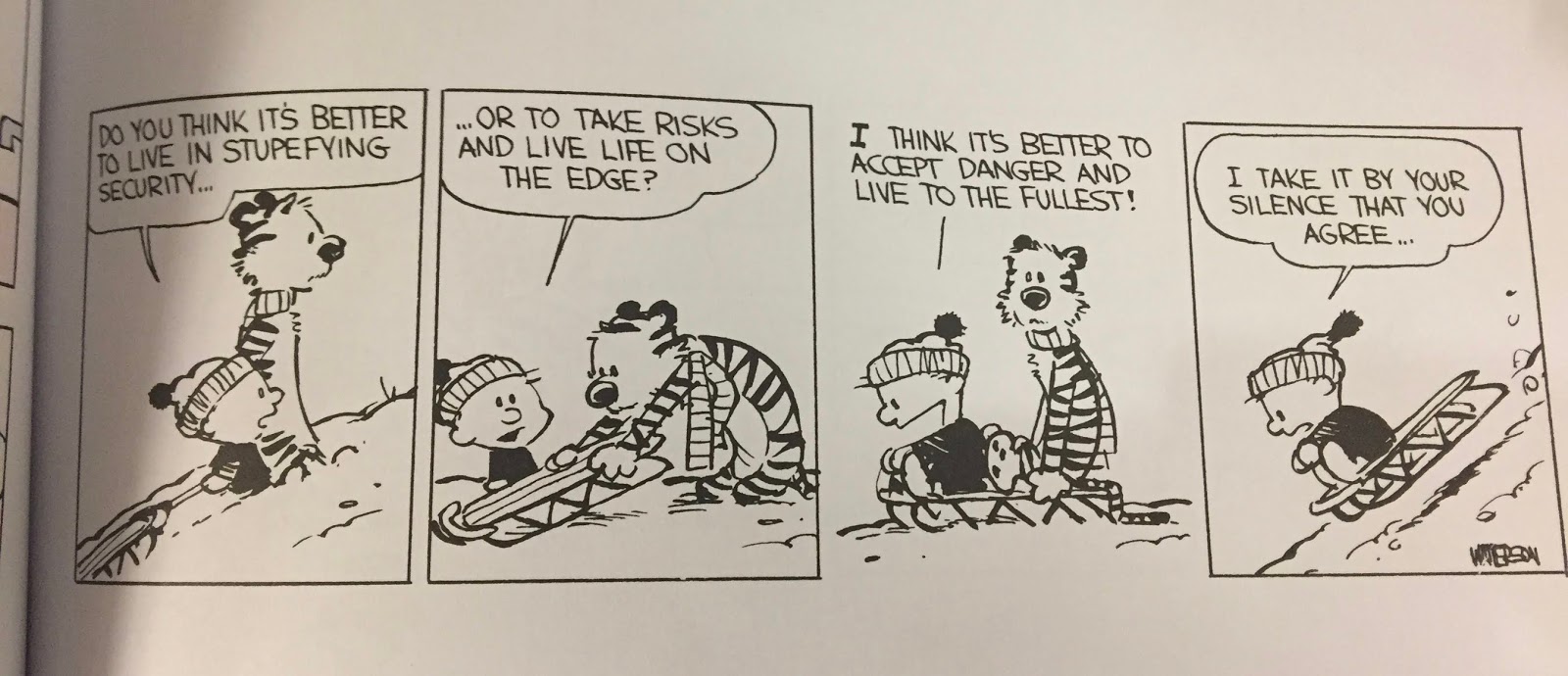
Other activities are available, such as ax throwing (I did not manage to make a single one stick to the target after the maximum five tries), sledding, viewing events on a Jumbotron, and more. The most fun activity is tobogganing, which I've wanted to do since reading Calvin & Hobbes as a kid. 
Comic strip copyrighted by Bill Watterson & re-produced under fair use exemption. 
The more people on the sled, the faster it runs, but if you go by yourself (like me), the experience will be just as much fun. 

Bonhomme, the name of the large, ubiquitous snowman, is the personable host of the Carnaval and can be seen chatting up guests and taking photos. 
Tickets to all events, in the form of a Bonhomme snowman "effigy," are sold for 15 Canadian dollars at the site. If you visit in 2019, I suggest taking a bus near Restaurant Le Grand Cafe (690 Grande Allée E), then walking up the hill to the main event area, where you can purchase tickets/effigies. Afterwards, walk the one kilometer to Le Chateau de Fronteac hotel, 
A popular location site for Hollywood movies
go tobogganing, 
then go downstairs to Quartier Le Petit Champlain to see more ice sculptures. 
Walking is easier than driving because many roads will be blocked to protect pedestrians and exhibits. I don't know whether this advice will be useful after 2019, but it worked for me. 

© Matthew Mehdi Rafat (2019)

Bonus: if you have time, you may also want to visit The Queen Elizabeth Hotel. In 1969, John Lennon and Yoko Ono spent a week there, where they recorded "Give Peace A Chance" while in bed surrounded by singers and fans.

Thursday, February 7, 2019

Book Review: Repetitive Tripe

Hordes of Mongols couldn't get me to pay more than one dollar for Jay Rayner's The Man Who Ate the World, which I found at a used library sale in, of all places, Stockholm. Another reviewer summarized it best: "You can equate the book to a dinner with good starters followed by a bland main course and even blander dessert." 
Rayner is a journalist turned restaurant critic; in other words, he lacks the kitchen experience of other reviewers like Anthony Bourdain, whom Rayner criticizes for his take on sushi rice. The only interesting parts of the book are when Rayner discusses his love of garlic buttered escargot and his wife--both of whom seem more capable of prose than himself. (February 2019) 

Bonus: Rayner references Star Trek, only to misspell Commander Worf as--I kid you not--"Wharf." Screenshot of page below. 

Wednesday, February 6, 2019

Elegy for a Blog (Not Yet)

I just discovered this old post. I was going to publish it in December 2011, but I put it aside and forgot about it.

________

I've been feeling a bit strange lately and needed to get out to a different locale. I used a free Southwest ticket and recently spent a few days in New Orleans. It was fun, but the trip didn't do much to resolve my internal miasma. I don't know if this is a midlife crisis, especially because I'm only in my early thirties, but it feels like I'm moving steadily forward into nowhere.

I had a list of goals to accomplish before I turned 30 years old, and I completed most of them. I thought I was aiming high--I included unique items like shaking Warren Buffett's hand, which I did at the 2007 Berkshire Hathaway meeting. I completed other goals earlier than I thought I would, like paying off my law school loans.

I haven't been able to come up with another list of goals. I recall reading about Ted Turner's dad telling his son to aim high and to set goals he'd never be able to achieve. That way, he'd always have something to keep him going.

I haven't really accomplished much anyhow, which makes my inability to write another "to-do" list puzzling. The older I get, though, the more I realize that people who get things done don't usually write about themselves a whole lot. They just focus on the task at hand, get it done, and move forward to the next task. They focus more on their family, their friends, their colleagues, and their local surroundings than abstract issues like the world, politics, or the stock market.

With my degrees in Philosophy, English, and law, I've probably spent most of my life dealing with abstract issues. While I cherish my general knowledge and experiences, it seems time to focus more on the here-and-now, which may help me re-gain the energy and optimism I had when I had nothing.

From a financial standpoint, I am currently mostly in cash/money market funds. I've been luckier than most--since December 2007, I've lost around 14% in my retirement accounts and made money in my regular accounts. In my retirement accounts, I will be looking to buy more TIPs (either TIP or VIPSX) and/or low-cost corporate bond funds (e.g., VWEHX, VCVSX). [Update: my positions may change at any time. Nothing here constitutes investment advice.] I will still attend shareholder meetings, and I may write about them on this blog; however, I foresee writing more book reviews and fewer posts (maybe once every month).

I continue to believe the most dangerous modern development has been the attenuation of community, i.e. the unnatural separation of things that used to go together, and the knowledge we gain and take for granted when we live with engaged people in an honest community. These days, neighbors don't know each other well; bankers don't directly own their mortgages; elected representatives listen more to lobbyists than ordinary people; schools don't teach children basic principles about government and economics, because no one can agree on the fundamental things anymore (not even whether torture is acceptable); people worry more about protecting their slice of the pie than increasing its size and longevity; families in larger cities need dual incomes so they lack the time to keep local governments honest; men, generally the more unpredictable gender, have fewer ways of proving their manhood locally and seem to unconsciously seek conflict to prove their importance; and war has become all too easy and no less horrific. In short, things seem to be falling apart; the center cannot be found, much less maintained.

The second most dangerous modern change is the failure of serious journalism. Read New York Times v. Sullivan to see the role America's founders expected of newspapers and media. Needless to say, it's a serious, substantial role--not one that bombards the public with Britney Spears, Lindsey Lohan, and Chris Brown. Imagine: without the Washington Post's (WPO) intrepid reporting, would we have known about Watergate? Fast-forward to recent times, and the New York Times (NYT) has caved into the government's "request" to delay publishing warrantless wiretapping reports.

How did we go from newspapers keeping the government honest to newspapers assisting the government in withholding information? Is it any wonder newspaper companies are going bankrupt? But without national newspapers to expose government corruption, who will fill the investigative void? TMZ? The Drudge Report? The National Enquirer? Will major newspapers revert to non-public forms so they can focus on investigative reporting? Or are financial interests so entrenched that it is too late to return to a more appropriate business model? The current situation--government and deficits becoming larger, while few credible entities have the resources to expose corruption and incompetence--is untenable.

I'm not one to leave on a dour note, so I will end with the following Theodore Roethke poem, which, to me, explains best where I'm at:

I wake to sleep, and take my waking slow.
I feel my fate in what I cannot fear.
I learn by going where I have to go.
We think by feeling. What is there to know?
I hear my being dance from ear to ear.
I wake to sleep, and take my waking slow.
Of those so close beside me, which are you?
God bless the Ground! I shall walk softly there,
And learn by going where I have to go...

I wake to sleep, and take my waking slow.
I learn by going where I have to go.

Thank you for reading. Feel free to come back once in a while.

Friday, February 1, 2019

DisneyWorld in Orlando, Florida

When I was a kid, I dreamed of visiting the Epcot Center and seeing Michael Jackson’s show. 
On the way to Canada, I stopped in Orlando overnight and took a bus to several Disney parks in the morning. It was surprisingly chilly in the morning and evening, but coming from Sweden, I was prepared. Sadly, as with most childhood memories, DisneyWorld didn’t meet the hype, though its hotel, guest relations, and airport transfer service (Magical Express) were fantastic. 
The different parks—spread over miles of land and asphalt highways—required a makeover. I tried visiting the gift shops at each park, but most of them were behind the ticket gates, an odd business decision. I liked the artistic touches, such as the cruise line bus painted like a ship, but after Tokyo’s DisneySea, I had high expectations for Disney’s flagship park. 
Unfortunately, like much of America in 2019, marketing (aka propaganda) exceeded reality, and infrastructure looked neglected. I strongly suspected I should have visited one of Disney’s newer resorts elsewhere. I had to wonder: will America realize it needs to catch up to the rest of the world, or will it continue to sail on its remarkable post-WWII (1945 to 1991) winds? In the alternative, am I just living the cliché that once you’ve left home, you can’t return because your perspective has changed irrevocably? 

Bonus: some practical advice: 1) do not bring any bags to the parks. There are separate security lines for visitors depending on their belongings, and the ones without bags or backpacks sailed through; 2) the cheapest hotel appears to be All-Star Sports, which has a 24/7 McDonald’s nearby, an opportunity to save even more money by eating meals offsite; and 3) Orlando’s airport is busier and less efficient than Ft. Lauderdale’s. My TSA check took about 20 minutes—after the 10 minutes wait in line to security. 
One of the All Star Sports complexes

Thursday, January 24, 2019

Scotland: Overlooked and Underappreciated

It took England 400 years to conquer the Scots, and they still haven't forgotten it. 
From Edinburgh Castle.
From the National Museum of Scotland.
The Scots--as independent as possible post-Acts-of-Union--print their own currency, 
Scottish currency is accepted in England, though I've never seen it.
fly their own flag, sing their own songs, have their own accent, 
From The Royal Dick pub in Edinburgh.
I promise I am not making up the name.
and mock the English every chance they get. One clue the Scots are more rational than their southern neighbor is they voted to remain in the EU, while the English voted to leave, throwing the U.K. into a political morass from which it still hasn't recovered. ("Pulling out doesn't stop people from coming," noted one political cartoonist on the immigration issue.) Interestingly, Scottish author Robert Louis Stevenson once wrote, "We all belong to many countries," a marked contrast to English PM Theresa May's 2016 comment, "If you believe you’re a citizen of the world, you’re a citizen of nowhere. You don’t understand what the very word 'citizenship' means." 
From Dean's I Must Belong Somewhere (2017)
Indeed, the Scots have a long tradition of rationality. They practically invented life insurance through the Scottish Widow's Fund, a pooling of funds for the elderly, 
From Armchair Books in Edinburgh.
and the Scots' list of inventions doesn't stop there. They also invented penicillin, the pedal bicycle, and Europe's first passenger steamboat (Montrose and Dundee's histories are inseparable from ships)--and that's only some of the "p"s. Growing up in California, where numerous parks are named after John Muir, I assumed he was Californian. In fact, he was born and raised near Edinburgh, and after moving to America, was instrumental in preserving Yosemite and other national parks. 
Outside Edinburgh's Writers' Museum.
Adam Smith, David Hume, the creator of Sherlock Holmes... the compilation of "Famous Scots You Didn't Know Were Scots" goes on and on. Even Englishwoman J.K. Rowling wrote much of the first Harry Potter novel in various Edinburgh cafes, where she moved to be close to her sister. (As a single parent, walking to nearby cafes was her preferred method for lulling her baby to sleep.) 
On bathroom wall of The Elephant House cafe.
Bluegrass and folk music in the American Appalachia? Their roots are Scottish, derived from songs Robert Burns collected on his local travels and modified. (One such song was "Auld Lang Syne"--which should not be confused with the delightful Auld Handsel Monday.) 
From Glasgow's Mitchell Library.
Despite their many accomplishments, the Scots harbor an inferiority streak larger than any steamboat they ever built. 

A recent best-selling book in Scotland? Poverty Safari: Understanding the Anger of Britain's Underclass--by a Scottish rapper. How does Scotland's pre-eminent historian describe his country? "A History of the Dispossessed." It's easy to forget now, with Scotland's North Sea oil wealth gushing everywhere since 1969, but much of Scotland was once a no-go zone. 

Between November 1930 and May 1935, Glasgow's unemployment rate was around 30%, and the Glasgow Razor Gangs, named for their weapon of choice, were running amok. As recently as 2005, only Finland had a higher murder rate in the developed world than Scotland. North Sea oil wealth still hasn't completely transformed mostly rural Scotland--
around 49% of Edinburgh, the capital, is made up of green space, and the reason some of the world's best strawberry jam comes from Scotland is because its relatively low population leaves plenty of room for farmland.
At the National Museum of Scotland (free admission), I came across a video of a Scottish government official lamenting the number of Scots leaving and taking their talents elsewhere, especially to Canada and Australia. 
From Le Chateau Frontenac in Quebec City
In the most poignant part of the video, a young couple discussed their thoughts on leaving Scotland. The wife did most of the talking until the very end, when the man chimed in, saying, "We Scots are hard workers." Indeed they are, mate. And from what I could see, mostly good people, too. 

© Matthew Mehdi Rafat (2020)

Bonus IRobert Louis Stevenson, on travel: 

For my part, I travel not to go anywhere, but to go. I travel for travel's sake. The great affair is to move; to feel the needs and hitches of our life more nearly; to come down off this feather-bed of civilization, and find the globe granite underfoot and strewn with cutting flints.

Bonus II: The name Edinburgh may derive from Northumberland; Edwin, the King of Northumbria from 616 to 632, built a town on the River Forth that became known as Edwin's Burgh.

Bonus III: Full disclosure: I attended first grade in Edinburgh, so I may be a wee biased in favor of the Scots. 

Wednesday, January 16, 2019

Kishore Mabubani in Singapore

Superpowers, Prophets, and Religion

Travel causes even the least observant to re-learn history. I began reading Ehsan Masood's Science and Islam (2009) last week, and I highly recommend the book. 
From what I gather so far, a world with two primary superpowers is not new. Masood mentions the Greek-Persian rivalry several times. (From my museum visits, I know the hatred between these two empires was so fierce, the Greeks engraved faces of defeated/dead Persians on their mead mugs.) 

Less predictable is the path of a new superpower. As America and the Soviet Union continued a costly rivalry from 1945-1991 and then from 2000 until 2016, China took advantage of their inattention, becoming a new superpower in just twenty years (1995-2015). No country can maintain supremacy if it expends energy and wealth fighting multiple fronts over an extended time period, a lesson every empire seems to forget. 

The Persian Sassanids and the Byzantine (Orthodox) Christians were similarly occupied with each other, allowing the untrained Arab Umayyad tribes and Bedouins to eclipse both empires within thirty years. Interestingly, such victories against outsiders occurred after Muhammad's (PBUH) death. For all the talk of the Prophet Muhammad's (PBUH) strategic prowess, his military career--as opposed to his economic and philosophical one--lasted only ten years, towards the end of his life, from 622 to 632, and after his first wife's death. (The Prophet Muhammad () was born in 570 A.D.) 

A diversion: Muhammad (PBUH) initially fled to Medina to escape assassination attempts; however, the polytheistic elites, his brethren in Mecca, continued to pursue him. Only after he moved from Mecca, his birthplace, to Medina in 622--when he was approximately 50 years old--did he authorize violence under the express limitation of self-defense:

Permission [to fight] has been given to those who are being fought, because they were wronged. And indeed, Allah is competent to give them victory. (Qu'ran, 22:39) 

Furthermore, Muhammad (PBUH) testified he was visited by the angel Gabriel/Jibril in 610 A.D.--at the age of 40--meaning he opposed elites and their excesses before receiving divine revelations, even though he belonged to the influential Qurayshi tribe. Like most changemakers, he was a rebel early on, disgusted by materialism (see Jesus's actions, overturning tables of moneychangers at temple), making friends with outsiders, including but not limited to African slaves. (FYI: though Abu Bakr, Muhammad's successor, was said to have light skin, we don't know if "light skin" referred to light brown or some other color.) 

Thus, for most of his life, Muhammad (PBUH) gained influence and protection through two sources: first and foremost, his older wife, an affluent, established merchant who trusted the younger Muhammad in part because he disdained materialism; and second, the poor, especially slaves, whom he freed, co-opted, and elevated into positions of authority (see stories of Bilal ibn Rabah, Salman Al-Farsi, and Suhayb ar-Rumi aka Sohaib ibn Sinan). ["Many of those who fought for Islam in the early years were among the poorest in the region." (Masood, pp. 24)] Regarding the second source, Muhammad's (PBUH) openness to outsiders surely arose because he was orphaned at a young age. 
The Bible's New Testament is starkly different than the Koran on the matter of slavery.
See 1 Peter 2:18.
As for other historical topics, Masood doesn't cover the Sunni-Shia split in depth, but I'll try to summarize here: some Shia scholars argue Muhammad (PBUH) united the numerous tribes and peoples of Arabia under a monotheistic and Abrahamic banner, only to have his work destroyed after his death in a military coup defying his succession wishes as set forth in his Ghadir Khumm speech. The Sunnis, for their part, see no conflict because Ali ibn Abi Talib, Muhammad's chosen successor, was eventually made into a Caliph and was too young to command a leadership position at the time of Muhammad's (PBUH) death. (Ali was eventually murdered in 661 in present-day Iraq.) 
Being too young didn't stop the Europeans from choosing successors,
perhaps their way of ensuring the military's influence.
If they want to pursue the matter further, the Shias might argue Umar/Omar--the same person who pledged allegiance to Ali at Ghadir Khumm--altered the Prophet's intended inheritance (the Fadak estate) to his daughter, Fatima Zahra, allegedly causing her to suffer a miscarriage and death less than three months after Muhammad's (PBUH) death. (Muhammad once said, "Fatima is a part of me. Whoever makes her angry, makes me angry.") The Sunnis may counter by saying succession is rarely a smooth process--almost every caliph after Muhammad (PBUH) and Abu Bakr was assassinated or poisoned, not just Ali ibn Abi Talib. Additionally, the Fadak estate was eventually returned to Fatima's heirs by an Ummayyad caliph. 

[Timeline: Abu Bakr (632 to 634AD), includes Ridda Wars (Arabic: حروب الردة‎) aka the Wars of Apostasy from 632 to 633; Umar I (634 to 644); Uthman (644 to 656); Ali (656 to 661)] 

Furthermore, while Husayn ibn Ali, Muhammad's (PBUH) grandson, was murdered under the Sunni Ummayads, their ancestors did not specifically target the Shias--after all, the Ummayads lost to the Abbasids, direct descendants of the prophet Muhammad, who were also Sunni. According to Professor M. Umaruddin of Aligarh University, the "Abbasids put to death not only all the members of Ummayad family but also all their supporters. They disillusioned the Shi'as by killing them wholesale." (The Ethical Philosophy of Al-Ghazzali) 
Succession and internecine feuds were common in Europe, too.
In fact, both the Sunnis and Shia can point to a third interloper, the Khawarij group, as the source of division within Islam. The Khawarij (aka the Seceders) were about 12,000 people, a hardline sect that refused to accept Ali's governance, eventually assassinating him. 

In any case, after 755 A.D. and after the end of Ummayad rule, "Persian culture and civilization asserted itself dominantly and triumphantly in the Muslim world." (Id., pp. 10) "Shi'ism in particular appealed to the Persians, who further developed the Shi'ite doctrines of the Imamate and evolved most of the transcendental theories about it. The two main sects of the Sh'ias, the sect of the Seven and the sect of the Twelve appeared during this period," a split once again caused by the familiar issue of succession. The Sixth Imam, Ja'far Al-Sadiq, disinherited his eldest son Isma'il, nominating his younger son Musa al-Kazim instead. It seems the Twelvists chose incorrectly, disappearing circa 873 AD, leaving the "Seventies" to follow the son of Is'mail, a man named Muhammad who favored allegories, storytelling, and even wine to interpret the Quran. (Id.) (Were Rumi, born around 1207, and his mentor Shams, born around 1185, influenced by the Seventies? I don't know.)  

As I was reading Masood's book, I realized another pattern in power replacement: the presence of a single unexpected defeat leading to the collapse of a long-standing empire. We've all heard of Napoleon's Waterloo and Hitler's invasion of the Soviet Union (starting in June 1941, with the winter in November 1941 destroying Germany's morale), but what about the battle of Yarmuk in Jordan in 636, where about 35,000 Arab Muslims defeated a Byzantine force of 100,000? Or the Battle of Badr in 624, where Muhammad's army of 313 men defeated almost 1,000 Arabs from Mecca? 
I'm reminded of Ernest Hemingway's quote about bankruptcy/collapse coming gradually then suddenly, a sentiment that seems to apply perfectly to empires in decline after an unexpected military defeat. 

Another pattern discussed in Masood's book is the speed by which a center of commerce or influence can shift. The Ummayads moved the center of operations from Mecca to Damascus, and Baghdad's intellectuals also seem to have moved to Damascus. Similarly, Constantinople immediately became an important city after the Byzantines moved the center of Christianity away from Rome. 

Yet, all empires drove away distinguished minorities even as they attracted intellectuals and new residents. For example, the Byzantines excluded Nestorians, who were Christians, but who had a different interpretation of Christ's role. Masood describes the Byzantines as fundamentalists who insisted on "a single interpretation of the nature of Christ," displacing minorities and non-conformist Christians as far away as China. 
It got me thinking: for most of human history, groups of minorities were rarely able to tell their stories in documents that survived intact, so we lack full knowledge about declining social cohesion and the numerous escalations that led to expulsions. Such gaps make it almost impossible to study complete patterns in historical displacement, rendering history books woefully incomplete. Consequently, when studying history, remember: you are learning a sliver of a sliver of a moment in time. Be humble. 

© Matthew Mehdi Rafat (2019)

Bonus 1: Europeans were not scientifically advanced until they came into contact with post-Islamic Arab civilization. See https://bahai-library.com/cobb_islamic_contributions_civilization#7 

"[V]irtually all the science and technology of the classic world had already been passed on to Europe by the Arabs - a process which had begun before 1100 and was completed by the time Constantinople fell. Although this Arab revival of classic learning was the chief influence in Europe's scientific awakening, this fact has been popularly disregarded." 

Algebra is an Arabic term. (So is mocha, in case you didn't know.) As for freedom, the first declaration of human rights comes from the Persians. See http://www.persepolis.nu/persepolis-cyrus.htm 

"The Declaration of Human Rights written by Cyrus the Great has been hailed as the first charter of human rights, predating the Magna Carta by nearly two millenniums." 

Finally, one reason the Persian Empire lasted around 430 years (224 to 651 A.D.)--longer than the Greeks and Romans (14 to 395 A.D.)--is because it was one of the most tolerant empires in the history of the world. 

Bonus II: Lisa Ling, in 2019, unintentionally showed a significant overlap between Arab Islam's and Genghis Khan's military success: "I think also in this period of class divide is really a moving one, because he was this character [Khan] who was a slave at one time himself, went on to conquer two thirds of the population of the earth, because he elevated people, he elevated slaves, and the lowest level of human to rise up in his army." 

A Bet on India vs. Japan: Arigato

I made a bet today with an Indian-American investor at the LKY School of Public Policy in Singapore. He is bullish on India and South Korea, whereas I am bullish on Japan. Incredibly, one of his arguments favoring India was citing Pakistan's bankruptcy (on a balance of payments metric) after the U.S. significantly decreased financial aid--as if being next to an allegedly unstable government with nuclear know-how is somehow advantageous. (The idea of being a local hegemon without competition is overrated in sane circles. The goal should be to become much better than your neighbors and trading partners, but not vastly so, lest you cause unpredictable dislocations.) 
From Bloomberg (2018)
Below is the email I sent to memorialize the conversation: 

Ten years from now, January 16, 2029, let’s chat, preferably in person over chai. 

You believe India will be both happier and economically stronger than Japan. I disagree. Japan has no enemies today other than its own past and its own resistance to controlled immigration. 

Meanwhile, India has the Kashmir issue; fluid borders; a nearby Pakistan with nuclear weapons (deployable with covert assistance from Russia); multiple languages; unfortunate racial demarcations because of the Hindu caste system's historical impact; and an economy where agriculture takes the lion’s share of employment. 

Ten years is not enough time to overcome such hurdles. Had you said 2050, I’d consider you competent. As it stands, “head up one’s arse” seems more apt. 

Monday, January 14, 2019

Jerran Young: Passing the Ball all the Way to the NBA?

There are two kinds of passers in basketball: the flashy "Pistol" Pete Maravich, Jason "White Chocolate" Williams, Earvin "Magic" Johnson variety, and the true PG type: John Stockton, Jason Kidd, Steve Nash, Mark Jackson, and Deron Williams. Unsurprisingly, true PGs rack up more assists over time. 

When I travel, I try to attend minor league sports games because it's a fun, inexpensive way to get to know a country. Basketball in particular is growing steadily in popularity, and American-born players, usually African-American, are responsible for its growth worldwide. I had the privilege of seeing Bobby Knight-coached Mike Singletary in both Indonesia and Singapore, and I now believe the Singapore Slingers' Jerran Young deserves a spot on an NBA roster. 
Young's passing is a work of art. No movement is wasted, no angle left inefficient. Despite plenty of action on the floor, I found myself just wanting to watch Young pass the ball to his teammates. 

Additionally, Young takes high-IQ shots, plays hard on defense (he had a come-from-behind block reminiscent of Tayshaun Prince on Reggie Miller), and is generally known as level-headed. If he has a weakness, it is his inability to hit the three-point shot consistently and his difficulty against stronger players in the post. Nevertheless, if America cannot find a place for him on an NBA G-League team soon, an entire generation of future players may never see a true PG or a pass the way it was meant to be. 

© Matthew Rafat (2019)

Michelle de Kretser, Australia's Most Interesting Living Writer

I'm about 1/4 of the way through my first Michelle de Kretser book, and I don't understand why I've not heard her name until now. I've already learned several new words ("loggia" being my favorite so far), and I've never seen such ease with the cultures of multiple countries. Kretser moves hilariously and fluidly from Sri Lanka, Singapore, Sindhi, to Sydney like no other author in human history
An example: "'Tamils do very well for themselves,' said Ash. 'They're hard-working, intelligent people. Terrifically good at maths.' He knew no Tamils but was repeating the same kind of thing his father said." 

Here's another one that made me chortle in glee: "Ash--as Ashoka preferred to be known--mentioned the dhal [daal] because he had noticed that women were moved by references to that aspect of his past. When they learned that he had lived in Sri Lanka as a child, they pictured him in a tropical garden where fruit fell to the hand, too innocent to divine the vicious historical turn that would soon cast him on the grudging benevolence of the West." 

Shame, shame on Australia for not doing a better job marketing its most interesting living writer. (January 2019) 

Saturday, January 12, 2019

Walls, Walls, Walls

Arguments against illegal immigration in America reflect the same nativist sentiments in mid-1900s Germany and other declining nations where existing political players blamed outsiders. Nuance and context--necessary components of a functioning, sane civilization--are always lost when outliers are used as the basis for broad-ranging policies.

The best argument against overzealous immigration hawks was made by none other than Martin Luther King, Jr.: "Anyone who lives in the United States can never be considered an outsider anywhere in this country." As an outsider, MLK reflexively sought to include others. His approach is wrongly considered naive or idealistic until one realizes the ability to remove every single stranger or potential risk of violent crime requires ongoing 24/7 surveillance and a police state--the opposite of a prosperous society. Voters should be reminded the safest place in the world is often a jail, or, for maximum security, solitary confinement. On this issue, American poet Robert Frost also has a poignant line: "Before I built a wall I'd ask to know / What I was walling in or walling out." 
NBA's John Wall, #2
The thinking class must not hesitate to make connections between an unthinking, violent police state and categorical sentiments against outsiders, including illegal immigrants. In matters of security, a healthy balance is always necessary, lest one lose the most precious of human riches: liberty, human dignity, opportunity, and justice. 

Thursday, January 10, 2019

Ideals of the 1960s Have Been Extinguished Worldwide

My country feels that money spent on weapons of war and armies is money wasted... security must be secured through the collective and effective strength of the UN... We seek a welfare state and not a warfare state... 

If independence and freedom are not to be empty slogans then we must continue to spend as much of our resources as we can on fighting the only war that matters to the people--the war against poverty, ignorance, disease, bad housing, unemployment, and against anything and everything which deny dignity and freedom to our fellow man. 

-- S. Rajaratnam's September 21, 1965 speech to the United Nations after Singapore's recognition as an independent country 
Chua Beng Huat on weakening of social welfare ideals since 1970s
What happens when trade agreements and the ability to transport your country's products to another country are linked to security agreements and weapons purchases? Today, Singapore's largest budget item is defense spending, and men are required to serve in the military. 
Chua Beng Huat
According to the pacifist Jehovah's Witnessesan established religion, as of December 2018, Singapore has imprisoned nine of their members over their refusal to serve in Singapore's military. 

In other news, Singapore's foremost living intellectual, Kishore Mahbubani has written, "Happy societies are also more resilient societies. We have had a happiness deficit for some time." (Opinion, The Straits Times, 12 July 2014, from Can Singapore Survive? (2015), pp. 108) 

Singapore will certainly survive, but will Singaporeans be as proud as they were in 1965? Will they be as happy or as honorable as LKY's generation? 

Bonus I: from Kishore Mahbubani's Can Singapore Survive? (2015)
Bonus II