Tuesday, April 23, 2019

Book Review: Dave Barry's Lessons from Lucy (2019)

I've been following Dave Barry since his nationally syndicated column in the Miami Herald as a teenager. (For those of you who don't want to research the timeline, that's about 20 years ago.) I wasn't expecting much from Barry's latest book--after all, it's marketed as "self-help," and Barry excels when he notices and mocks the ordinary. "Mocking" and "earnest self-help advice" don't mesh well, so I figured Barry was just cashing in on his name and reputation to pay for his daughter's college tuition. Boy, was I wrong. This book is one of Barry's best. 
First, if you are a dog lover, you have to get this book. Second, if you're not a dog lover, don't worry--Barry refers to Lucy after his usual storytelling, using her as a sort of canine muse. The book does get overly sentimental in places, but only three or four times total. (e.g., "Do not be afraid to say these words: I was wrong. I made a mistake. I'm sorry. I apologize.") 

More common are the following thoughts, such as when Barry participates in a corporate pro-diversity program: "Inside we were seething. We were ready to go out and join the [Ku Klux] Klan. Even the black employees." 

I'll end with one of Barry's best paragraphs: "So what I'm saying to you, especially if you're getting up in years, is: Don't settle for contentment. Don't just stand around grinning. Get out there. It's a wonderful world." 

© Matthew Mehdi Rafat (2019) 

Monday, April 15, 2019

A Short Manual to Nonviolent Undermining of Nations

You are about to read an 11-step manual on how to dissolve social cohesion. It may seem malicious to promulgate such methods, but once you realize any nation or people can become evil and callous, the need for defensive tactics becomes obvious. You don't have to follow all the steps below, but a combination applied consistently and over enough time will be lethal. 

Civilizations die from suicide, not by murder. -- Arnold Toynbee 

1. Promote Extremism, especially in Politics 

Most people believe evil and decay enter with belligerence. In reality, too much of anything can lead to destruction. If you cannot defeat your enemy by violent means, then promote the most shallow, superficial, and/or extreme people within their societies--regardless of ideology

Obviously, national politics is the most ideal arena, but you can start small. Look at public schools (ignore nepotism, whether formal or informal), police departments, and local governmental bodies. Even a city planning commission, if staffed by zealous nitpickers or inexperienced lawyers, can help disintegrate faith in one's fellow citizens. 

Above all, review anything related to debt or inflation. A public or private bank that loans too much money to the wrong people or too little money to the right people will create problems. In peacetime, only the banking and natural resource exploration sectors have specialized instruments capable of causing as much damage as a ten-tonne bomb (see, for example, America's 2008-2009 crisis). 

2. Trust, Nuance, and Context are Conjoined

Some people genuinely believe others "don't want to know how the sausage is made." Agree with them by eliminating nuance and reducing transparency as much as possible. The human mind wants to focus on single or binary data points to understand complex issues. Feed that bias using true but incomplete information. With the media becoming fully digitized and therefore subject to SEO manipulation and the highest bidder, social targeting is easier than ever before. Aim to create a lack of trust through selective reporting and/or the elevation of simplistic viewpoints

We are pragmatists. We don't stick to any ideology. Does it work? Let's try it, and if it does work, fine, let's continue it. If it doesn't work, toss it out, try another one. We are not enamored with any ideology. -- Singapore's founder Lee Kuan Yew 

3. Ignore Potential 

Not actively promoting and nurturing exceptional persons is a surefire way to lose them, whether through physical departure to other nations or a loyalty shift. 

Remember: immigration is a zero-sum game. If you can attract the best and brightest into your nation or group from a competitor, with each person, you create an almost insurmountable 200% gap in your favor. We universally acknowledge stealing ideas is easier than inventing them, or that not all new ideas will succeed; yet, voters seem unable to understand immigration is the exact same process, but applied to people. 

You will know you have succeeded if any prominent politician mentions building a wall

4. Use Idealists and Conformists within Minority Groups 

History tells us empires fail when they openly discriminate against minorities. A wise leadership prefers instead to set extremely high or impossible standards anyone can allegedly reach, then manipulate the budgeting, promotion, and/or selection process to assist his or her friends and allies.

Prices are the new discrimination. -- Chris Rock (2017)

If journalists or others expose inconsistencies or discrimination, it is not difficult to find conformists, idealists, or egotists within the allegedly harmed group and then elevate a single person from that group while maintaining the status quo (e.g., America's President Obama). 

5. Inane Distractions Thwart Substance 

Promote voyeurism and gossip. Louis Brandeis said it best: 

"Triviality destroys at once robustness of thought and delicacy of feeling. No enthusiasm can flourish, no generous impulse can survive under its blighting influence."  

Divert the target's attention from the long-term to the trivial and short-term. 

6. Attack the Artists 

The smartest people in any country are usually comedians. If you can goad leaders into condemning or banning a comedian, you will cause an immediate and permanent loss of credibility.  Hypocrisy is everyone's hemlock, whether governments, individuals, or corporations. 

The same logic applies to authors and musicians. Stalin murdered Leon Trotsky in Mexico in 1940; the Soviet Union dissolved in 1991. Detroit's police department shut down an NWA concert in 1989; the city filed for bankruptcy in 2013. The time frames may differ, but once top level officials try to control art, enough mistakes have been made that the end is inevitable. 

Interestingly, Governor Ronald Reagan assailed UCLA professor and writer Angela Davis in 1969, and California in 2019 is America's most unequal and indebted state. Also in 1969, the NYPD raided Greenwich Village's Stonewall Inn, a bar in a well-known counterculture district. According to the New York Times, six years later, New York City was so close to bankruptcy, "the city's lawyers were in State Supreme Court filing a bankruptcy petition." By the time the Establishment's list of scapegoats includes bohemians, everyone with means has packed their bags or already departed with them. (Americans will be pleased to know as of April 15, 2019, President Donald Trump has not called for the jailing, deportation, or murder of any artists.) 

[Bonus, from professor Danielle Morgan, Spring 2021: "It demonstrates to me the power of comedy that former-President Trump would get so angry that he'd not come to the White House Correspondents' Dinner. He would take to Twitter and yell about Saturday Night Live. Trump spent so much of his time attacking entertainers and, in particular, comedians because he knows that comedy reaches the masses very quickly and very convincingly.]

7. Inefficient Governments Cause Problems 

As religious entities moved into the government's traditional role of providing social welfare, most governments welcomed them, assuming they could provide services more cost-effectively. Yet, how many people realize religious entities have gained credibility through community services because their governments are inept or misusing their tax dollars? Or that the more influence the government allows religious entities in social services, the less one can argue in favor of separation of religion and state? 

The more you can promote religion in everyday public life, the more you can fragment society. Wise governments neither promote nor denigrate religious entities in exchange for noninterference. 

The 1st Amendment leaves the Government in a position not of hostility to religion, but of neutrality. The philosophy is that the atheist or agnostic... is entitled to go his own way. -- Justice William Douglas in Engel v. Vitale (1962)

8. Promote Segregation and Informational Fragmentation 

Segregate different groups of people as much as you can. Most people associate segregation with racial characteristics, but separation based on wealth, education, information, or some other trait eventually leads to intractable inequality and hubris. 

Heed the following Martin Luther King Jr. proclamation and do everything you can to render it untrue: "Anyone who lives inside [our country] can never be considered an outsider anywhere within its bounds." 

9. Fear is Your Friend, Curiosity is Not 

Of her profession, journalist Amanda Ripley once wrote, "we know how to grab the brain’s attention and stimulate fear, sadness or anger. We can summon outrage in five words or less." Notably, she states that it is "impossible to feel curious... while also feeling threatened." 

Almost everyone knows the U.S. government deliberately lied to the American people and American judges in multiple egregious instances, including but not limited to the Gulf of Tonkin incident and Korematsu v. United States, 323 U.S. 214 (1944). Yet, almost no one believes psy-ops (aka propaganda) to shape public opinion and legislative action exist as regular, ongoing events. Maintain this naïveté. 
Indigo Girls, 2002

10. If You Can Collapse a Building by Taking Down One Pillar, Don't Try to Destroy Three

The more open a society, the more fragile it is. If your paradigm assumes the executive, legislative, and judicial branches--all of them--are required for society to function smoothly, remember that only one of these branches need be corrupted or disdained to cause decline. 

11. Overextend the Enemy 

If you succeed using the above methods, governments and societies will be unable to ignore their problems and may defend themselves using censorship, jails, torture, and other blunt instruments. Once you are in this stage, the goal is to cause the target to overextend itself as much as possible and to abuse its power. 

For example, after 9/11, America knew it could not legally torture detainees but did so anyway, in no small part because its political and military leadership specifically drafted exceptions to time-honored procedures. "Black sites" for interrogation or "extraordinary renditions," often in cooperation with other nations, eventually led to a total breakdown in decency, causing the United States to lose credibility worldwide, despite being the victim of a vicious, cowardly attack. 

Abu Ghraib, the most prominent example of America's decline, occurred outside the nation's official borders as a way to escape oversight from the media and courts. The American government even argued its knowing creation of a loophole to evade judicial oversight meant it deserved the power to destroy not just the enemy, but its own checks and balances. (See also President Bush's Executive Order 13224, which "prohibited transactions not just with any suspected foreign terrorists, but with any foreigner or any U.S. citizen suspected of providing them support.") 

Overextension renders a society imbalanced, leading to extreme actions becoming accepted as new norms. Shift the norm as far as you can in any direction. 

12. It's Always Been the Same Old Story

All governments have the same general issues: overpopulation or underpopulation and immigration; employee unaccountability and selection; foreign capital and influence, especially in the media; debt repayments; access to resources, including sustainable food production; effective regulation of competitors, whether criminals or corporate, without endangering innovation; and security without overextension, which includes infiltrating influential groups and gaining intelligence

If you ever find yourself thinking you've discovered something new rather than being put in a position to communicate existing and older ideas more effectively using ever-changing mediums, remember my grandmother's advice: "Don't worry so much. In the end, life is mostly eating, f*cking, and sleeping." 

Good luck

Sunday, April 14, 2019

On Elizabeth Warren's Tragic Banality

Bloomberg News recently reported Democratic presidential candidate Elizabeth Warren and her husband earned almost 1 million USD in 2018, proving America's national politics are a contest between the out-of-touch and the even more out-of-touch. (Two days after the media disclosed her income, Warren attended an event with boxes from Dunkin' Donuts, America's working-class brand.) Outsiders like Bill Clinton, Barack Obama, and Donald Trump are popular because they seem relatable, but are they really so different? 

Both Bill and Barack were raised by single mothers and became Ivy League lawyers, an unorthodox but similar path. Donald Trump graduated from the Wharton School, part of an Ivy League institution. Elizabeth Warren's husband is an Ivy League law school professor and she herself is a former Harvard law professor. It appears the American presidency is reserved for the Ivy League, which may explain voter disenchantment and America's fascination with anyone politically incorrect. 

The Democrats' tone-deaf support of Warren should come as no surprise, especially after Hillary Clinton's nomination. Like Hillary, Warren is an excellent candidate on paper. She has brothers in the military, supports unions, and is hostile to big banks, all positions designed to attract as many voters as possible. Her oft-mocked claim of Native American heritage makes sense in light of Oklahoma's broadly-defined affiliation and her team's desire to market her to all possible groups. Yet, I am falling asleep as I write this, and I had ample energy (and coffee and tea) before I began writing. 

It's tempting to say Ivy League institutions extinguish students' ability to be appealing or authentic, but JFK, who had a surfeit of charisma and appeal, is a Harvard graduate and therefore an Ivy Leaguer. Before him, the most maverick Supreme Court Justice, William O. Douglas--nicknamed Wild Bill--attended Ivy League Columbia University. 

Perhaps it's the times we live in? Eighteen years of perpetual warfare, extrajudicial killings (including at least one U.S. citizen), hundreds of thousands of civilian deaths overseas, and the fecklessness of the legal establishment couldn't have helped, but I think the matter goes deeper. When we allowed our politicians and intelligence agencies to call civilian deaths "collateral damage," the American spirit was diminished. The minute Democratic Secretary of State Madeline Albright casually dismissed 500,000 child deaths resulting from her government's policies, "American leadership" became an oxymoron. The moment Congress began using semantics to stretch the definition of torture, America's moral ground was lost. Today, we speak of compassion as if it is a foreign or missing element in our society, and we may be right. 

I've always believed human intuition is underrated--one particular scene from Carl Sagan's Contact plays in my mental background whenever I debate--and as we move closer to a society controlled by machines, whether physical or digital, we allow our culture to be further dictated by numbers and data unable to understand integrity or compassion. As such, our current endgame is necessarily dystopian, though even dystopian fiction fails to realize its heroes and heroines would not exist in a society where surveillance has been perfected. 

Indeed, the primary glue holding societies together is not money, security, or education but genuine interest in one another. Family matters because such interest is presumed, but whether we succeed depends on how broadly each familial unit can extend its definition of family. A cap exists on how much stretching can occur, a limit inapplicable to semantics or data, a fact that ought to make us more skeptical of anyone or anything refusing to acknowledge inherent bounds. 

Speaking of limits, if Elizabeth Warren is nominated as the Democratic Party's presidential candidate, it will represent definitive evidence her party is so far removed from reality, the time for a viable third party or independent candidate has finally come. Warren has no humility, no workable original ideas (her anti-trust proposals are copied from the EU), and no charisma. When she does have an original idea, it makes no sense (this often occurs when someone has never run a business or personally filed tax returns). For example, her latest idea to tax corporate profits above 100 million while disallowing various credits or deductions may have extinguished Amazon Web Services and allowed China's Alibaba to dominate world commerce. In short, Warren is incapable of shielding honest citizens from the tidal wave of complexity involving unions and Wall Street; business and immigration; military and industry; education and politics; inflation and necessities; overlapping jurisdictions and accountability; and entitlements and debt. 

A society collapses not when a tyrant is elected, but when the opposition cannot admit its mistakes and proffer practical solutions. This counterintuitive dynamic occurs because tyrants are elected or put into power when societies finally realize--always too late--they are on the wrong path. To reverse decline, the opposition, which has been asleep, must 1) admit it has misjudged the facts as well as the remedies (including a failure to co-opt more radical elements within its ranks); and 2) correctly identify the numerous factors that have brought everyone to the present-day situation. Absent this humble, analytical approach, the tyrant will continue to prevail by canceling programs s/he deems unnecessary, then diverting revenue to allied interest groups, thereby solidifying his/her power. 

In the end, progressives need to realize "checks and balances" are just words in legislators' books and inherently inferior to paper conferring financial gain. (If nothing else, Donald Trump knows this aforementioned truth.) No judge or lawyer has ever been able to withstand the chaos spread by a climate of fear combined with the wholesale disintegration of government funding to existing large groups. The number of paths to a police state are many and simple, while the way out is labyrinthine and difficult. Let's hope Americans realize Elizabeth Warren gives them the most difficult maze possible for a re-emergence. 

© Matthew Mehdi Rafat (2019) 

Thursday, April 11, 2019

Mom's Birthday

Me: [Taking photos of Mom, texted her the photos] 

Mom: [in Al Pacino's Godfather tone] "What is this? I'm in my pajamas! In my pajamas! Where did you put these photos?"
Me: "Facebook, Twitter, Instagram."

Mom: [Realizes I'm joking] 


Me: "Ok, I just sent it to Marjan [my sister]."

Mom: [Silent] 

Me: "Wait, this would make a good blog post." 

Mom: [Still silent] 

Wednesday, April 10, 2019

Summary: House Judiciary Committee Hearing on Hate Crimes (2019)

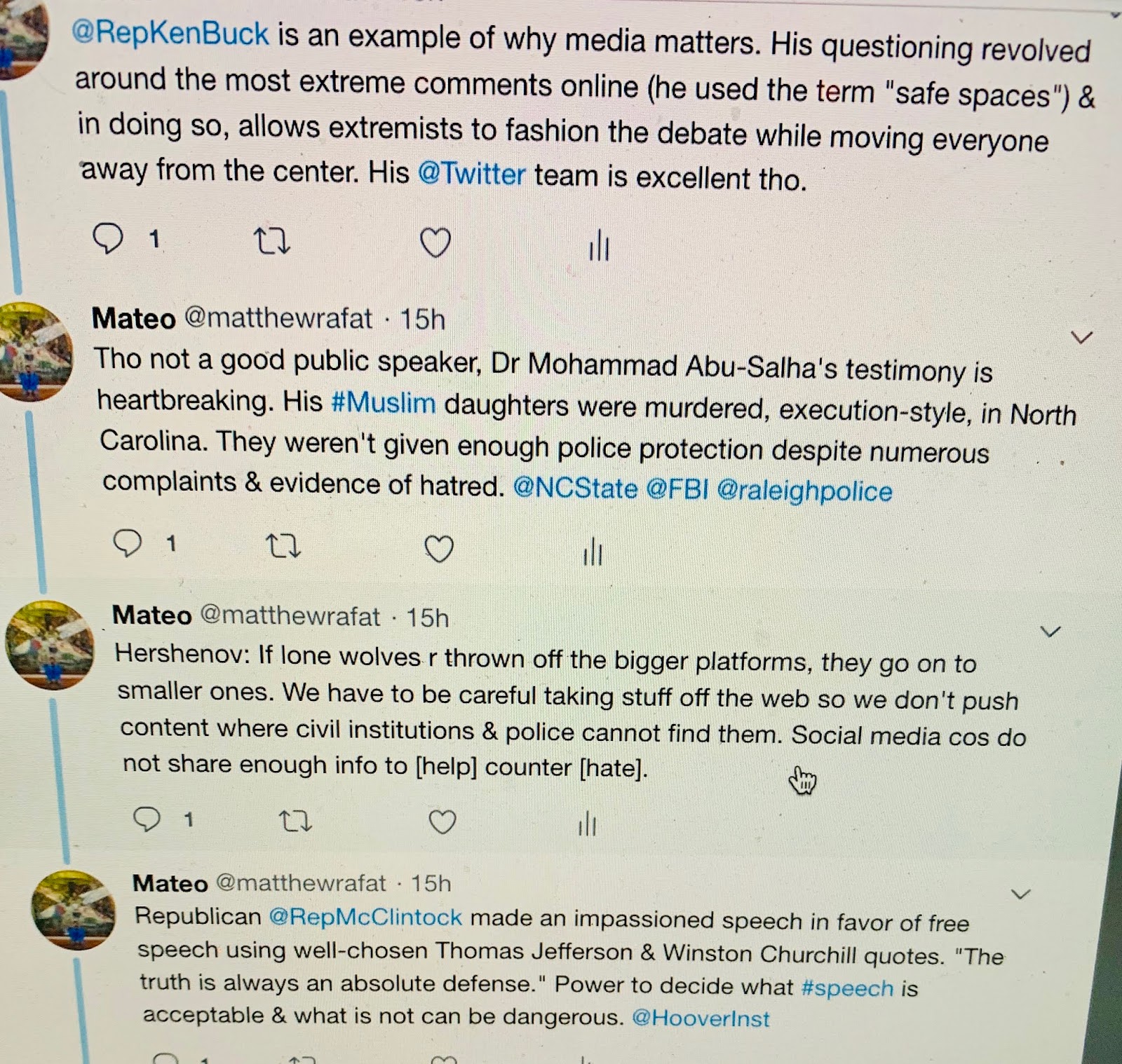
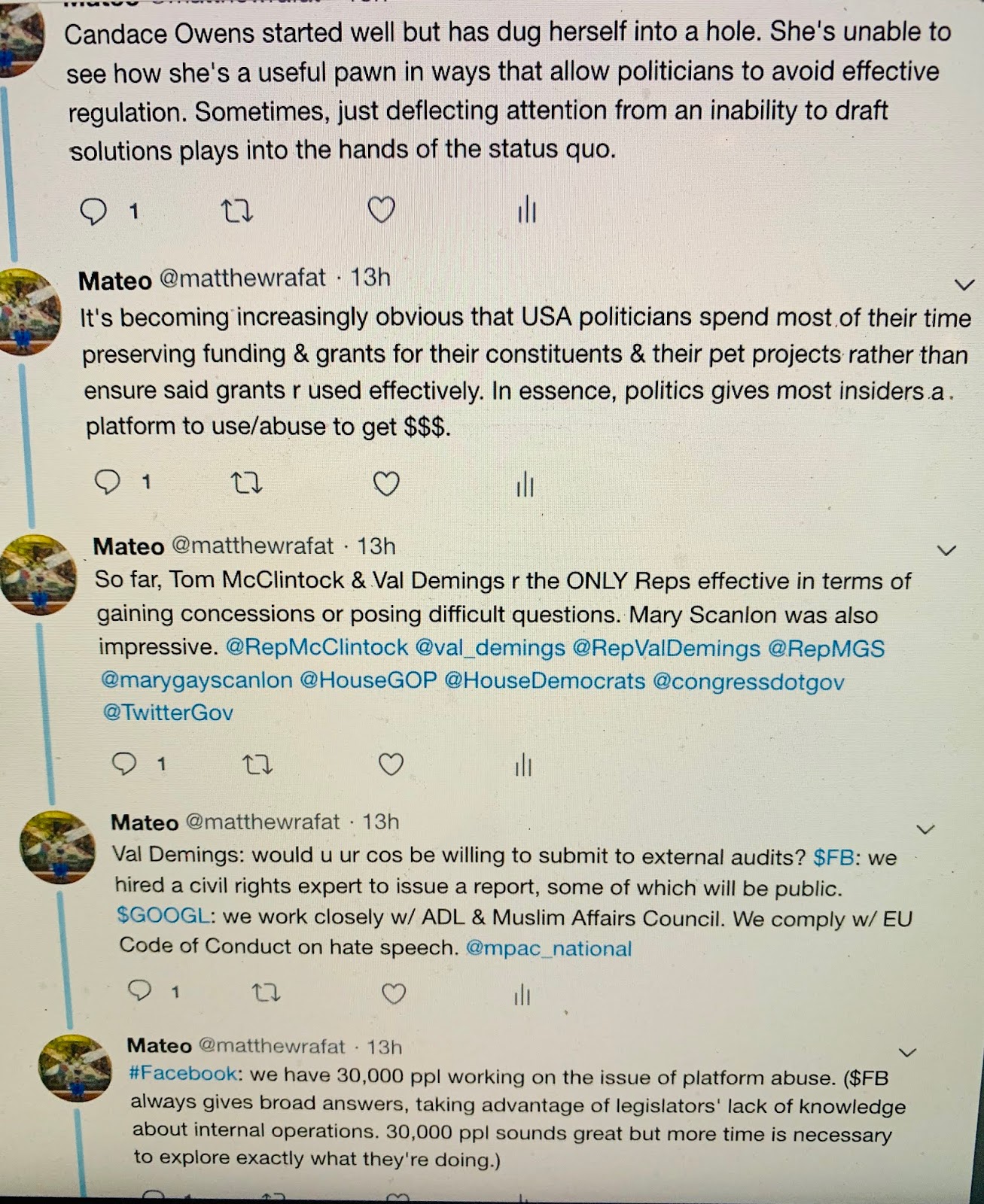
At the House Judiciary Committee's hearing yesterday to examine and discuss white nationalism and hate crimes, Google admitted to manipulating search results based on subjective factors if content was controversial, i.e., "on the border." Only Rep. Tom McClintock of California pushed back hard, saying the power to decide what speech is acceptable and what is not can be dangerous. 

I've personally had an innocuous comment I tried posting on Instagram blocked before I was able to post it, showing the reach of AI. The reason given in the pop-up box was that I was "bullying" an Iowa wrestling coach and former Olympic contender, but no reasonable human being would classify my criticism as bullying. As Rep. McClintock pointed out, "bullying" can be pretext to censor legitimate criticism, and in doing so, prevent progress and transparency. On a more basic level, allowing corporations power over acceptable speech could also become a way to extract an "advertising tax" on individuals and businesses to resolve an image issue if they are caught in an algorithm's web. Such a dynamic feeds monopolies (and more difficult anti-trust enforcement) by favoring large over small businesses. 

People in positions of power ought to be scrutinized fairly and on all the facts. An unaccountable entity--whether corporate or government--picking and choosing which facts to include or exclude enables poor leadership. Worse, it prevents local leaders and voters from properly utilizing their powers, causing a loss of credibility on all sides and potential backlash (e.g., President Trump). By the way, that Iowa wrestling coach I tried posting a comment about? Almost no one knows he was accused of sexual assault, leading to an interesting (and public) court battle (Brands v. Sheldon Community School, 671 F. Supp. 627 (N.D. Iowa 1987)). 

My Twitter recap of the hearing is below: 

Two other issues arose: 1) many states lack appropriate hate crime laws, so the federal government should consider establishing a better minimum baseline; and 2) both state and federal laws do little to nothing to address widespread "doxxing" problems, i.e., revelation of private contact information specifically for purposes of harassment. 

Friday, April 5, 2019

Book Review: One Day by David Nicholls

It's so hard to find a good love story these days, one wonders if love itself is hiding in the shadows, waiting for someone to properly articulate its existence. David Nicholls did his best in 2009 with his book, One Day, adapted into a film starring Anne Hathaway. The film is good--I admit to crying at the end, despite knowing the plot--but not a true adaptation. 
From the beginning, Hathaway was a risky choice to play a rebellious, Doc Marten's-wearing character with a pen Shakespeare would envy. We see glimpses of youthful defiance when Hathaway wears an anti-war t-shirt and peace buttons on her jacket, but she plays the character as Desdemona to a second-tier Othello, whereas Nicholls wrote her character as far more interesting, more punk genius than lovelorn robin. 

Let me do my best to fill in the gaps in case you make the mistake of not reading the book. We all know the "Cinderella meets Rich Prince" motif has been explored to death, but Nicholls infuses Emma Morley with such verve, no one would dare think her inferior in any way to her would-be prince, Dexter Mayhew. Sadly, the film omits the written correspondence between the two protagonists as they travel in different directions, keeping in touch except for brief periods. Like Cinderella's spic-and-span work ethic, Emma's letters establish her as unjustly downtrodden, her descriptions of colleagues and roommates alternating between comedy and tragedy: "I asked him [a fellow theater actor playing a slave] to get me a packet of crisps [aka chips] in this café the other day and he looked at me like I was OPPRESSING him or something." 

It is within these same letters we understand Emma's unconditional love for Dexter, springing from the vast differences between them, including his privileged upbringing: "I know your whole childhood was spent playing French cricket on a bloody great chamomile lawn and you never did anything as déclassé as watch the telly..." Cinderella never mocked her prince, nor displayed the aptitude to do so, which is why such Disney stories are unappealing to intelligent adults. In contrast, Emma uses Dexter's status as modern-day royalty to showcase her sharp wit, and in doing so, make him a better man. Consequently, the best comparison to One Day isn't Cinderella or Othello, but a transposed riff on Pretty Woman, with Richard Gere's charm intact but his money replaced by intelligence: "Yes, you had to be smart, but not Emma-smart. Just politic, shrewd, ambitious," Dexter tells himself while considering career options.  

And yet, Dexter isn't exactly the male bimbo caricature the film makes him out to be. It's true the director makes us ache for Dexter's lost potential at every turn, at one point giving him as vacuous a girlfriend as imaginable, a showbiz tart who makes Kim Kardashian look worthy of a Nobel Prize in Physics. Dexter's portrayal is unfair because first, he's lost his mother to cancer, which clearly upends his very being, given his emotional distance from his disapproving father (who, interestingly, married a woman far more classy than he deserved, as both the film and book insinuate--at least until the very end). 

Moreover, unlike the stereotypical bimbo or cad, Dexter knows he's not smart, so he tries to find a niche where he can prove his worth. He knows the entire time he can't compete on any level-playing field in the real world, which is why he's so ashamed to face his mother's expectations, and why he's so smitten with Emma: "Without her[,] he is without merit or virtue or purpose..." For her part, Emma knows she's the perfect foil for Dexter, and without him, she wouldn't have a punching bag, er, muse capable of helping her reach Tysonian or Lewisian heights. Unfortunately, the film underestimates its audience by expressly telling us their union is about opposites attracting, even giving Dexter a ying-and-yang ankle tattoo (at least it wasn't on his lower back). 

There are so many ways to interpret the book--the proletariat's place in a bourgeois world being just one of them--I'll stop and let you explore Nicholls' writing yourself. If you've already seen the movie, here's one excerpt that should give you an idea of the book's higher workmanship: 
Here's to smart, witty, kind women. If you find one who loves you, cherish her and have a nice life. 

© Matthew Rafat (2019)

History Repeats Itself Because the Political Class Lacks Imagination and Courage

Everyone seems agog over Anand Giridharadas' ideas, but I'm not impressed with him--or anyone else commenting on America's slow but steady descent into an amoral police state. In fact, the more I study American history, the more I realize America's leaders have been repeating mistakes by copying ideas from the past without realizing different times need different solutions. During the most recent recession, for example, Congress was atwitter over whether to extend unemployment insurance, and it eventually did--copying its exact response from the Eisenhower era over fifty years ago: 

Q. Mr. Vandercook: Do you have in mind so far any intention of proposing legislation to assist the States to continue unemployment benefits beyond the 6 months' period, as that 6 months, in many instances, is running out? 

THE PRESIDENT. I have forgotten for sure whether that was in the bill that went to the Congress or not. I remember the subject was discussed by Mrs. Hobby in front of me, and I would have to ask Mr. Hagerty to give you the exact thing as to whether it was actually in the bill. 

From 2013-2014, Congress extended unemployment insurance by 3 months, then continued it another 3 months. (See HR 3546, 3813, 3824, 3936, etc.) Why the sameness? Here's where Anand Giridharadas succeeds: he points out the political class has no real interest in changing the status quo anywhere

Now go and look at the kinds of people who enter politics. In almost every single case, they are from an affluent background or lack the real-life experience to overcome secondhand information (President Obama and the military, etc.). If you are someone who genuinely desires to avoid humanity's cycles of political failure, which model do you turn to? The obvious answer is nonconformity, but that approach requires an engaged, compassionate, and principled class of youth. Pray tell, where are they? 

Wednesday, April 3, 2019

What's Up, Doc?

For as long as I can remember, I've wanted a pair of Dr. Martens workboots. Considering my total ignorance of punk rock and grunge, I don't know exactly what inspired this lifelong desire, but I suppose I know counterculture when I see it. Today, I received my first pair of Doc Martens' boots in the mail. Since I refuse, on Scottish-infused principle, to purchase any shoes costing more than 50 USD, I had to wait until I found an oddly-colored one on sale. (Tip: before buying, ensure you understand the differences between British and U.S. sizes--they're not the same.) 

The story of Dr. Martens' is an example of globalization and perfect timing. Though the boots are associated with Britain, the creator was actually a German military doctor named Klaus Märtens aka Klaus Maertens. A partnership with a friend from Luxembourg resulted in the business opening in Seeshaupt, Germany, where their comfortable boots were a hit with older women. That's right--Dr. Martens, now a counterculture fashion brand, succeeded because older women with foot problems cared more about comfort than style. From humble beginnings, eh? 
When a family-owned British boots company noticed the German design in an advertisement, it realized the comfortable soles would be perfect for blue-collar workers and purchased an exclusive license. After altering the heel and adding a yellow welt stitch and a two-tone grooved sole edge, Dr. Martens began production in the U.K. on April 1, 1960. As I said, the timing could not have been better: to be born on the cusp of a counterculture revolution means as long as you maintain quality, your brand will never die. 
A newer style. The company is trying to appeal more to a younger generation.
Sadly, Dr. Martens' lifetime guarantee no longer applies: 

From the 27th of March 2018, the For Life range will be discontinued. Dr. Martens will continue to honor all existing For Life guarantees on purchases made before the 29th of March 2018 and registered within 60 days of purchase. The For Life registration website will be deactivated on or about the 25th of May 2018.

If you bought a pair of boots before March 29, 2018 and registered it, you were the last consumers eligible for the authentic Dr. Martens experience. Being a Johnny-come-lately bloke, I'll be buying another pair in the distant future. On that date, I'll go as original as I can: the no-frills black ones, sale or no sale. 

Tuesday, April 2, 2019

Time to Reduce Exposure to American Stocks?

I told my U.S.-based family members to raise between 10% and 20% cash in any and all stock/investment accounts. I personally wouldn't mind if my sister and brother-in-law increased their cash/money market holdings to 30%, but they are young, and their youth makes it hard to suggest a more conservative allocation. (It doesn't help that bonds paying interest in U.S. dollars seem to be fairly valued.) My parents, who don't generally listen to me, told me they're already all in cash. 

I am still holding onto my General Electric (GE) shares, along with various REIT and other preferred shares, but I do not see much value in U.S. equities markets as of April 2, 2019. 
Shiller P/E is one useful metric to consider for overall valuation.
I suppose Kraft Heinz Co. (KHC), which I recently bought, looks cheap, but its debt load is considerable, and I don't have many shares of it. I like a few other individual U.S. stocks besides GE, but I allocated a considerable amount of my holdings to GE at an average of approximately $12.50/share, and I'll wait for a turnaround. I do hold a few international companies, but none I like enough to suggest publicly. If you're reading this post, good luck, and do your own due diligence. I am not an oracle of anywhere when it comes to investing. 

Disclaimer: The information on this site is provided for discussion purposes only. Under no circumstances do any statements here represent a recommendation to buy or sell securities or make any kind of an investment. You are responsible for your own due diligence. To summarize, I do not provide investment advice, nor do I make any claims or promises that any information here will lead to a profit, loss, or any other result. I am not responsible for any harm arising from following anything construed as advice herein. 

Miscellany

1. S&P 500 closed on 2867 on April 2, 2019, the date of this post. 

2. GE stock is around 9.26/share mid-day April 8, 2019. 

3. KHC is around 33.22/share mid-day April 8, 2019. 

Update on November 7, 2019 

1. S&P 500 closed on 3076 on November 6, 2019. 

2. GE stock closed at 11.02 on November 6, 2019. As far as I know, I have sold all my individual shares, but my positions may change at any time. 

3. KHC closed at 33.14/share on November 6, 2019.

As of November 7, 2019, I have a conservative portfolio, but my positions may change at any time. 

Update on February 1, 2020

The recent correction has caused me to deploy some of my cash. I have bought shares of XOM, CVX, PSX, GT, MUR, and various REITs. My positions may change at any time. You are responsible for your due diligence. 

Update on April 28, 2020

Markets declined substantially in 2020 because of the COVID19 pandemic, hitting a recent low on March 23, 2020 but have since retraced most of their losses. Though indices declined between 10 and 20%, REITs and oil companies declined around 40 to 50%--and have yet to fully recover. I continue to hold banks and oil companies, which are still paying dividends. Facebook's Libra digital currency has not made much progress, indicating USA banks are still strong as long as they co-opt or harness blockchain technology. I have not had General Electric (GE) stock for a while now. As always, m
y positions may change at any time. You are responsible for your due diligence. 

Update on March 24, 2021

GE stock closed at 12.50/share today. I did not benefit from the full recovery because I sold most or all of my GE shares a while ago. 

KHC closed at 38.23/share today. As with GE, I did not benefit from the full recovery because I sold most or all of the shares a while ago.

The S&P 500 closed at 3892 today. 

American indices have hit all-time highs or close to all-time highs. I have raised considerable cash, but my positions may change at any time. You are responsible for your due diligence.  

Thursday, March 28, 2019

G. Willow Wilson: Deceptively Unassuming

For what she's accomplished, G. Willow Wilson ought to be the most cocky, arrogant person in the room, the archetypical superhero fond of snippy remarks. Instead, she's unassuming and kind, and you'd barely notice her if she didn't happen to wear a headscarf. Even her single-colored choice--unlike most Arab Muslims, who favor multi-colored, ornate patterns--is indicative of her desire to blend in. 
At East Bay Booksellers in Oakland, CA
And yet, despite her best efforts, Wilson simply cannot blend in. Following the same path as C.S. Lewis from atheist ("I was desperate for the secular truth that seemed so self-evident to other people.") to religion, she finally found a home in Sunni Islam after a journey taking her from Colorado's Rocky Mountains to Egypt, then Iran, leading to several profound epiphanies, including this one: 

"[W]hen a dictatorship claims absolute authority over an idea--in the case of Iran, Islam, in the case of Egypt, a ham-fisted brand of socialism--frustrated citizens will run to the opposite ideological extreme. [Consequently,] The Islamic Republic was secularizing Iran; in Egypt the short-robed fundamentalists multiplied and multiplied." (The Butterfly Mosque

I recently started one of her books, and I'm eager to see what's in store the rest of the way, especially after a passage as perfect as the following: "But I didn't yet have faith in faith--I didn't trust the connections I felt between mountains or memories, and if I had been a little more ambivalent, I could have allowed the Zagros [mountains] to be foreign, and the memory to be coincidence. Fortunately, I didn't." 
Rumble, young woman, rumble
Wilson was in Oakland, California to promote her latest book, The Bird King (2019), about a royal Spanish concubine and a mapmaker able to create maps from imagination, and in doing so, conjure the actual place. Despite her nonfiction and fiction oeuvre, Wilson is more famous for her rendition of Kamala Khan as Ms. Marvel in the comic book universe. Contrasting her books with her comics, Wilson said comics are challenging because the writing must be more structured and planned so the plot-lines don't conflict with anything or anyone in the shared universe. Surprisingly, despite the level of historical detail required for a novel like The Bird King, she doesn't outline: she writes, and in the process of writing, makes numerous notes to herself in the margins, reminding her to return to a certain passage to complete an idea or not to overlook a character's unique traits. 

Writing about ordinary people in a historical context was difficult--what shoes did Spain's Muslims wear, did they have chimneys?--but Wilson enjoyed the research, inspired by a DNA analysis revealing a tiny bit of Iberian and North African blood in her mostly Italian ancestry. For insights into costumes during the relevant time period, Wilson used Libro de los Juegos (Book of Games) by Alfonso X of Castile, published around 1283. 

She enjoys going on book tours because readers see things authors themselves haven't seen or patterns that can be invisible to the author. Her agent wishes she'd write a multi-volume series like Harry Potter, but she just writes in ways that make sense to her rather than setting out to create a particular comic book universe or "world building." Wilson finished her presentation by reading aloud from the first chapter of The Bird King, which she called "one of the most personal things I've ever written," about "finding love and lost knowledge." 

If you're a fan of unplanned journeys and finding love and knowledge in peaks and valleys, try to see G. Willow Wilson on her current book tour. Look for the woman trying her hardest to blend into the crowd, as if she were hiding a secret--perhaps even a superhero costume underneath her clothes. 

© Matthew Mehdi Rafat (2019)
Soniah Kamal explains Jane Austen

Despite a degree in English and several classes on Western/British literature, I've never finished a single Brontë or Jane Austen book. I relied on CliffsNotes, yellow and black summary booklets that save countless American college students. 

Older now, but none the wiser about British literature, I had a chance last night to ask author Soniah Kamal about Austen's pull on so many women, especially intelligent, highly educated ones from affluent families. Her response was brilliant, rendering me able to understand Austen's allure for the first time--a feat none of my college professors managed. 
Soniah Kamal with interviewer Rebecca Richardson
Kamal began by explaining Austen isn't about romance, but about social satire. More specifically, Austen used her pen to mock everyone, especially the upper classes. It's important to remember Austen grew up in a time when options were limited because of her gender. "Keeping up appearances" was vital for women to gain comfortable lives through their most straightforward avenue: marriage, a one-shot deal due to divorce being rare or available only in ways making wives destitute. 

Sadly, in Austen's time, women's dependence on men, whether brother or stranger, was almost total. Existing laws mandated inheritance to male heirs, so a father with three daughters and no sons would likely pass his entire estate to a male cousin--no matter how distant. To summarize, women's chastity and behavior were linked to familial reputation, which in turn was necessarily conservative because a lack of economic opportunities, coupled with sexist laws, buried women alive under social constraints. (My crude belief that the Brontë sisters and Jane Austen suffered from an inability to achieve orgasms, causing them to transfer their Victorian passion into literary dramas now seems grossly unfair. We can also see how such strict norms led to other injustices, most notably in the area of race relations, but that's another topic.) 

Kamal's approach is unique in that she recognizes such social constraints also buried men, who may not have wanted to support a family or even to get married. (Note Jane Eyre's Edward Rochester character, who was tricked into a bad marriage.) Kamal's multi-faceted explanation also helps us understand why Austen's modern-day audience tends to be affluent and educated, despite Austen herself being neither royalty (e.g., a Lady) nor rich. Though she wrote about what she knew, a scope neglecting the working classes, the quality making Austen's writing timeless is her recognition that marriage and "high society" involve appearances for the sake of social inclusion--and, more importantly, that such status can be lost with a single poor choice. (See "Bag Lady syndrome.") 

These themes of social inclusion and social mobility based on superficial traits mean every time someone buys a Louis Vuitton wallet or a Birkin bag, s/he's bringing Austen to life. When we watch Carrie Bradshaw buying a pair of imported Manolos, Austen is lurking in the background, waiting to pounce. Considering that most first marriages, even today, occur at a very young age and are therefore dependent in large part on familial support and reputation, Austen's work seems less outdated. Indeed, it's more accurate to say her muse midwifes itself from rebellion against social repression and constraints rather than Victorian-era sexual mores. Given the universality of youthful rebellion in the context of strict parents, Kamal joked that Austen didn't realize she was Pakistani, Bangladeshi, and perhaps even Italian. 

Let's talk about Soniah Kamal. My first impression was a woman once constrained by social norms, now ready to let loose--but in a manner befitting her social stature. Kamal, born in Pakistan and raised in London and Saudi Arabia, where she attended an international school, won't be seen anywhere near a dive bar, but her alligator skin shoes and colorful dress and scarf tell you she wants to be seen. And yet, I never once saw a prurient quality in her. Observing a photo after taking one with a fan, she decided it didn't meet her standards and told the photographer to "stand up" and try again. The photographer obliged. 

Incredibly, Kamal wrote her latest book, Unmarriageable (2019), a fusion of Pakistani culture and Jane Austen, in two months. She advises aspiring writers, often told to picture their audience that "There is no audience. You are your audience--write what interests you." 
Fans of Austen are familiar with a surfeit of emotion hidden under prim surfaces, and Kamal sheds tears easily. Waterworks occurred when she discussed a reader's poignant note; the unexpected revelation some people were using her book as a gateway to Jane Austen, her original inspiration; and two other instances. Despite my newfound respect for Austen's desire to give her characters more agency on the page than they had in real life, I won't be reading Austen's books. There are too many interesting female writers today, including G. Willow Wilson (The Butterfly Mosque), Chimamanda Ngozi Adichie, Michelle de Kretser (The Life to Come), Zadie Smith and, yes, Soniah Kamal. 

© Matthew Mehdi Rafat (2019)

Bonus I: "For what do we live, but to make sport for our neighbors, and laugh at them in our turn?" -- Jane Austen 

Bonus II: from Kwame Appiah's The Lies that Bind (2018), on Jane Eyre: